19 May 2016

Macon's First Presbyterian Church

Bryan-Aldean Concert 2008 021Established in 1826, the First Presbyterian Church at Macon, Georgia today sits across from the Bibb County courthouse.  The church arose just three years after the city was chartered.  The building seen here on Mulberry Street was erected in 1858.  It's on the National Register of Historic Places, and had the distinction of being the tallest structure in Macon from 1858 until 1903, when the building of St. Joseph's Catholic Church was completed.

From historical marker:
THE FIRST PRESBYTERIAN CHURCH
Organized as the Presbyterian Church of Macon on June 18, 1826, by the Rev. Benjamin Gildersleeve and the Rev. Joseph C. Stiles, the church dedicated this house of worship, its third, on September 19, 1858, at the close of the ministry of the Rev. Robert L. Breck.  Mr. Stiles was the first pastor; Matthew Robertson and Samuel B. Hunter, ordained October 14, 1827, the first elders.

This church was host for formation of the Synod of Georgia in 1844 with Dr. Thomas Goulding, founder and first president of Columbia Seminary, as moderator.  His son, the Rev. Francis R. Goulding, author of The Young Marooners, served here in the 60's by preaching to the Negro members, who withdrew to form Washington Avenue Presbyterian Church in 1866.  This is the Mother Church also of Tattnall Square (1887), Vineville (1904), and East Macon (1906).

It was the younger Goulding who took over the city-wide Thanksgiving service commanded here by Union General Wilson at the close of the War Between the States because the pastor, the Rev. David Willis, was overcome by the mockery of the occasion.  Goulding's service consisted of reading Psalm 137 "…For they that carried us away captive required of us a song…".

In the church vestibule is a plaque honoring Sidney Lanier, who was a member here.
As you can see from the map below, the First Presbyterian Church of Macon is not far from Rose Hill Cemetery.  In this cemetery, I would expect, is where many members of the congregation were laid to rest.


Two such members were Frederick F. and Julia Ann Lewis.  They were named as among the first members in an 1875 newspaper article.

lewis20088ph

Bryan-Aldean Concert 2008 020

Bryan-Aldean Concert 2008 022
(As an Amazon Associate I earn from qualifying purchases.)

24 March 2016

Sheriff Wyatt's Jail in Greensboro

Almost three years ago, I wrote in this space about Greensboro, Georgia's Spooky Old Gaol.  This structure was used to house (and hang) criminals until about 1895.  At that time, a new jail was established.  After the death of legendary Sheriff L. L. Wyatt, that "new" jail (though more than eighty years old at the time of Wyatt's death) was given his name.

100_3774Outside the jail is a historical marker that tells the tale of the professional life of Sheriff Wyatt:

"SHERIFF L. L. WYATT

This 1895 jail is named for the legendary Sheriff, Loy Lee Wyatt, who enforced the laws in Greene County for fifty-two years until his death in 1977.  Sheriff L. L. Wyatt was born on January 2, 1904, in Paulding County.  He was recruited to serve the citizens of Greene County due to his fast legs and honest reputation.  In 1925, L. L. Wyatt began his law enforcement career as a Greene County policeman who waged a "one-man war" against the making of illegal corn whiskey.  Prior to his arrival, moonshine production was considered the leading industry in Greene County and its product was enjoyed in all of the finest hotels of Atlanta.  After having rid the County of its moonshiners, Wyatt ran for the Office of Sheriff in 1940 defeating the incumbent.  He served as Sheriff until he died in 1977.  At the time of his death he was the longest standing Sheriff in the State, with thirty-seven years of service.

During his 37 years as Sheriff, Wyatt became a legend in his own time.  Few men become legends and even fewer achieve the status of a "living legend" as did Sheriff Wyatt.  He was a religious man who believed that God blessed him with protection during all of his fights, gun battles, and dangerous encounters.  His law enforcement exploits exposed him to at least five gunshot wounds in the line of duty, in part due to the fact that he seldom carried a gun on his person, requiring him to retrieve it from his car at the sight of danger.  In the early days of his career, when

(Continued on other side)

100_3775moonshiners resisted arrest, Wyatt regularly shot it out with them.  He killed over a half dozen men, all of whom shot at him first.

The most famous gunfight of Sheriff Wyatt's career occurred in 1974.  He was 70 years old at the time.  Bank robbers eluded a 100-car police chase that started in Wrens, Georgia, and ended in Greene County.  The bank robbers had killed a teller at the bank in Wrens and had taken two women hostage.  Sheriff Wyatt set up a road block midway between Union Point and Greensboro.  Wyatt stood in the middle of the road as the speeding car approached.  The robbers attempted to shoot him, but the gun misfired.  One bank robber was killed in the ensuing battle, but both women were unharmed.  Sheriff Wyatt subsequently received the award of Peace Officer of the Year for his bravery in this incident.

Sheriff Wyatt was a family man, devoted to his wife, son, and grandchildren.  He was a businessman, lending his experience to the operation and affairs of the Citizens Union Bank as a director.  He was a community leader who had concern for all citizens – rich and poor, black and white.  Out of a concern for these people, legend has it that Sheriff Wyatt confronted a notorious member of the Dixie Maffia and proclaimed, "These are my people and I want you to leave them alone!"

Sheriff Wyatt, also known as Mr. Sheriff, was the epitome of a community oriented police officer long before such an idea was born and served as an example for every officer to follow."

According to his burial notice in the Augusta Chronicle (Georgia, 11 April 1977, sec. A, pg. 11, as viewed online at GenealogyBank), Loy Lee Wyatt died 8 April 1977 "after he was stricken with an apparent heart attack." The notice goes on to say, "During his tenure [as Sheriff], Wyatt gave Greene county a reputation as one [of] Georgia's most crime-free areas.  Along the way, he was shot five times and narrowly escaped death twice in car crashes during chases."

Sheriff Wyatt was laid to rest at Greensboro Cemetery.

100_3776


22 March 2016

The Blue Ridge Mineral Springs

Mineral springs are naturally occurring springs that produce water containing minerals that some claim give it a therapeutic value.  Salts and sulfur compounds are among the substances that can be dissolved in the spring water while it travels underground.

Resorts sprang up around these springs in the 19th and early 20th centuries when it was popular for (usually wealthy) people to travel to such places and "take the waters." An 1886 newspaper article spoke of such a treasure in Whitfield County, Georgia, saying it contained "this pure medicinal beverage gushing from the Blue Ridge Mountains." Two counties over, due east of Whitfield, is Fannin.  In 1905, it was discovered the town of Blue Ridge in Fannin County had at least three mineral springs.  Rev. Joel Butts, pastor of the Blue Ridge Baptist Church found the springs, cleaned them out, and had the water analyzed.  It was determined that drinking the water from these springs would benefit one's general health because it contained magnesium, iron, and sulfur.

Walking trail along Mineral Springs Creek.According to theblueridgehighlander.com, "today there are no longer any mineral springs available for visitors to submerge in, even though un-maintained springs still do exist on private property in the area if you know where to look." In April 2015, a walking trail was opened in a place where one of the springs could once be found.  According to an old picture on an informational marker along the trail, the spring was outfitted with what looks to be a gazebo, a common practice of the time.

The creek that runs through the area is simply called Mineral Springs Creek, and you can see where the mineral spring itself once was, as denoted on this map.

The walking trail is part of a very pretty and well kept 13 acres.  I've visited it a couple of times.  Walking along and listening to the quiet waters of the creek flow by is very peaceful.  It's also cool to think people have been coming to this same area for the same rejuvenating purposes for more than 100 years.  As local resident Eva Baugh said when describing the springs, "Even if you didn't drink the water, it was a good place to visit and gossip."

In the following image, the creek bank to the left is approximately where the spring once was.

Mineral Springs approximate location.

I've only known about the walking trail less than a month.  I read an article that stated the site was once a dump.  I don't know if that was to be taken figuratively or literally.  Whatever the case of the recent past may be, I'm glad the area was cleaned up to a space that can be enjoyed by many.  And I'm especially thankful the historical significance is not lost.

(As an Amazon Associate I earn from qualifying purchases.)

01 September 2015

The Monument to Col. Samuel Hammond

More than 100 years ago, a monument was placed in Augusta, Georgia in memory of Colonel Samuel Hammond. He was a patriot, a soldier, and a statesman who "gave 60 years of public service to the cause of America." It was the hope of Col. Hammond's grandson, Hugh Vernon Washington, that the momument be sculpted and located in Augusta. Unfortunately, he did not live to see it come to fruition. When the monument was presented to the city, it was by Ellen Washington Bellamy, Hugh's sister, on his behalf.

Via Waymarking.com.

Augusta Chronicle (Georgia)
29 March 1913, pg. 7
SAMUEL HAMMOND LIVES IN MEMORY

Monument to Patriot of Country's Early History Presented to Augusta by His Descendants

DR. M. ASHBY JONES ORATOR

Accepted on Behalf of City by Mayor L. C. Hayne -- Exercises Presided Over by Judge William F. Eve -- Mrs. Bellamy, of Macon, One of Donors

The presentation to the city of Augusta of the monument to Col. Samuel Hammond of revolutionary fame was a most impressive event of yesterday afternoon. The granite boulder, upon which the heroic bronze bust of Colonel Hammond is to be placed, is erected on the 600 block of Greene Street. At the hour of 5 o'clock, a crowd of interested spectators gathered and the presentation ceremonies began upon the arrival of Mrs. Ellen Washington Bellamy, of Macon, who is one of the donors of the monument, the other donor being her brother, the late Hugh Vernon Washington, of Macon, a grandson of Colonel Hammond...

Mayor Hayne's Acceptance
..."For over a century his [Colonel Hammond's] remains have rested unmarked on the banks of our own Savannah, where the holiest requiems have continuously been sounded from the winds that blew over the grave of this intrepid hero, who dared to die, that his country might live...

Mrs. Bellamy Speaks
Mrs. Bellamy then spoke a few words of appreciation, explaining that it was the wish of her brother, the late Hugh Vernon Washington, of Macon, that this monument be erected in Augusta, whose history their illustrious ancestor helped to make, and that the monument was his gift as well as hers...[Entire article may be viewed online at GenealogyBank.]
According to Waymarking.com, Samuel Hammond was born September 1757 in Richmond County, Virginia. He died at Varello, near Augusta, September 1842 (on the South Carolina side of the Savannah River).

Regarding Col. Hammond's Revolutionary War career, the monument provides:
WITH GENERAL GREENE IN EVERY IMPORTANT
ENGAGEMENT THROUGH VIRGINIA,
THE CAROLINAS AND GEORGIA: ON THE FRONT
LINE AT EUTAW, COWPENS AND KINGS MOUNTAIN.
AT THE SIEGE OF CHARLESTON,
SAVANNAH AND AUGUSTA
The news article above implies Hammond's grave was unmarked in 1913. It is definitely marked now, with a military marker and a 5 foot pyramid. According to his FindAGrave memorial, "In 1991, the grave of Colonel Samuel Hammond was relocated to the Hammond Family Cemetery on the property of the Charles Hammond house in North Augusta, SC from it's original location 1.6 miles away in New Richmond, SC because of the development of the Riverview Park Complex."

12 May 2015

The Naming of Atlanta (Tombstone Tuesday)

Plainly put, Atlanta was built on the railroad. Lucian Lamar Knight, in Georgia's Landmarks, Memorials and Legends, says it this way:
...[T]he chief factors in Atlanta's phenomenal growth are the railway lines which converge at her civic center, there forming a web of steel, from the bi-focal points of which they radiate in every direction.
In an effort to connect railroad lines within the state, a point seven miles east of the Chattahoochee River was picked as a spot "best suited for running branch lines to various towns within the State." This point was called Terminus, defined as "an end point on a transportation line or the town in which it is located."

A man named Hardy Ivy was the first person to purchase a tract of land and build a shanty, before the town was surveyed, in 1836. It wasn't until 1842, when a new track was tested -- and considered a success, that the town began to really come to life with the building of new stores and churches.

Wilson Lumpkin, an ex-Governor of the state, was at this time one of the commissioners appointed to supervise the building of the Western & Atlantic Railroad. Lumpkin helped re-survey the land, fixed a site for the depot, and negotiated enough property for terminal facilities. Many wanted to rename the town after Lumpkin in appreciation for the prominent part he played in laying off several land lots. He refused, so people circumvented his protest a bit by renaming the town after his youngest daughter, Martha.

In This Spot Set Apart By The City Is Buried
Martha Lumpkin Compton
August 25, 1827 - February 13, 1917
Wife Of Thomas M. Compton
Daughter Of Governor Wilson Lumpkin
And His Wife Annis Hopson Lumpkin
In Honor Of This Lady, Atlanta Was
Once Named Marthasville

Oakland Cemetery at Atlanta, Georgia

ATLANTA'S NAMESAKE DEAD
(Associated Press)
DECATUR, GA, Feb 13 -- Mrs. Martha Lumpkin Compton, after whom the city of Atlanta was twice named died at her home here tonight at the age of 90 years. In 1844 the village now called Atlanta, was named Marthasville in her honor. Four years later it was named Atlanta after the nickname of "Atalanta," which Mrs. Compton's father, Governor Wilson Lumpkin had given her. [Montgomery Advertiser (Alabama), 14 February 1917]

11 May 2015

Park for Nancy Hart, a Revolutionary Heroine

Lucian Lamar Knight described her as an "undaunted queen of the forest..."

NANCY HART
On Wahatche (War Woman) Creek, in Revolutionary times, lived Nancy
Morgan Hart, her husband, Benjamin, and their children.  Six feet tall,
masculine in strength and courage, Nancy Hart was a staunch patriot, a
deadly shot, a skilled doctor, and a good neighbor.  A spy for the colonists,
she is credited with capturing several Tories.  Later, with her son, John, and
his family, she joined a wagon train to Henderson County, Kentucky,
where she is buried...A replica of her log home, with chimney stones from the
original, is in the Nancy Hart Park, [in Elbert County.]

"The most famous story of Hart's escapades as a frontier patriot began when a group of six (some accounts say five) Tories came to her cabin and demanded information concerning the location of a certain Whig leader. Only minutes earlier, the Whig, hotly pursued by the Tories, had stopped by the Hart cabin and enlisted Hart's aid as he made his escape. Hart insisted that no one had passed through her neck of the woods for days. Convinced that she was lying, one of the Tories shot and killed Hart's prized gobbler. After ordering her to cook the turkey, the Tories entered the cabin, stacked their weapons in the corner, and demanded something to drink. Hart obliged them by opening her jugs of wine. Once the Tories began to feel the intoxicating effects of the wine, Hart sent her daughter Sukey to the spring for a bucket of water. Hart secretly instructed her to blow a conch shell, which was kept on a nearby stump, to alert the neighbors that Tories were in the cabin.

As Hart served her unwanted guests, she frequently passed between them and their stacked weapons. Inconspicuously, she began to pass the loaded muskets, one by one, through a chink in the cabin wall to Sukey, who had by this time slipped around to the rear of the building. When the Tories noticed what she was doing and sprang to their feet, Hart threatened to shoot the first man who moved a foot. Ignoring her warning, one Tory lunged forward, and Hart pulled the trigger, killing the man. Seizing another weapon, she urged her daughter to run for help. Hart shot a second Tory who made a move toward the stacked weapons and held off the remaining loyalists until her husband and several others arrived. Benjamin Hart wanted to shoot the Tories, but Hart wanted them to hang. Consequently the remaining Tories were hanged from a nearby tree. In 1912 workmen grading a railroad near the site of the old Hart cabin unearthed a neat row of six skeletons that lay under nearly three feet of earth and were estimated to have been buried for at least a century. This discovery seemed to validate the most oft-told story of the Hart legend." [snippet from New Georgia Encyclopedia article, "Nancy Hart (ca. 1735-1830)"]

Click here for Nancy's FindAGrave memorial.


Update! Here's another tidbit I learned from Lucian Lamar Knight:
Hartford One of Georgia's Lost Towns.
Hartford, the first county-seat of Pulaski, formerly stood on a high bluff of the Ocmulgee River, just opposite the site of the present [1913] town of Hawkinsville. It is today numbered among the dead towns of Georgia, but in the early days of the State it was an Indian trading post of very great importance, on what was then the frontier...The town was named for Nancy Hart, the celebrated heroine of the Revolution. In 1837, the court-house was removed from Hartford to Hawkinsville, dating from which event the fortunes of the little border stronghold began to decline, until it became at last only a dim memory of the remote past; and there survives today but a few fragmentary remains to mark the spot.

02 May 2015

Heardmont: the Home of Gov. Stephen Heard

Gov. Heard's Home
Off this road lies the site of Heardmont, home of Governor Stephen Heard,
1740 - 1815, and "God's Acre," the family cemetery where he lies buried.  A
ten acre park surrounding the site is owned and maintained by the Stephen
Heard Chapter, D.A.R.  A Virginian of Irish descent, Heard came to Georgia,
establishing Heard's Fort, now Washington, Ga., in 1773, and fighting with
Gen. Elijah Clarke at the Battle of Kettle Creek where he was captured.
As President of the Council, he was de facto Governor for a period in 1781.
After moving to Heardmont he was one of three who selected the site of
Elberton.

"Near the outskirts of the little town of Heardmont, in the eastern part of [Elbert] county, stood the old home of Stephen Heard, the founder of Washington and one of the most noted of Georgia's early patriots and pioneers. It was called Heardmont, from the name of the owner. The residence is said to have been the first lathed and plastered house in this part of the State, and when the contractors were building it people came miles to see the handsome structure. In appearance it was not unlike the old Heard house at Washington, with a double veranda enclosed by tall columns. The furniture was of solid mahogany purchased in London. The home was destroyed years ago. But the little cemetery is still to be seen and the monuments are well preserved." [Georgia's Landmarks, Memorials and Legends by Lucian Lamar Knight (1914), pg. 537]

Gov. Heard's Grave
Stephen Heard, Governor of Georgia in 1781, lawyer, planter, surveyor
and soldier of the Revolution, lies buried in this family cemetery...Heard's
home "Heardmont" once stood nearby...


In the family burial ground at Heardmont lie the mortal remains of the old patriot. The inscription on his tomb is as follows:
Sacred to the memory of Colonel Stephen Heard. He was a soldier of the American Revolution, and fought with the great Washington for the liberties of his country. He died on the 15th of November, 1815, in the 75th year of his age, beloved and lamented by all who knew him. "An honest man is the noblest work of God."

All photos © 2011-15 S. Lincecum.

18 April 2015

Walter T. Colquitt, by Lucian Lamar Knight

Walter T. Colquitt
[Wikimedia Commons]
The following is a sketch of Walter T. Colquitt, namesake of Colquitt County, as penned by Lucian Lamar Knight for his 1914 publication, Georgia's Landmarks, Memorials and Legends:
Judge Walter T. Colquitt was one of the most brilliantly gifted of Georgia's ante-bellum statesman. As an orator his achievements on the hustings have rarely been excelled; he was also a minister of the gospel and a jurist of high rank; and by reason of his prestige as a popular leader he was elected to a seat in the Senate of the United States. Judge Colquitt came of English stock and was born in Halifax County, Va., on December 27, 1799. His boyhood days were spent in Hancock County, Ga., whither his parent removed and he received his education in the famous academy at Mt. Zion. Later he located in Columbus, where he continued to reside until his death. He was twice elected to Congress as a Whig; but, on the nomination of William Henry Harrison, he gave his support to Van Buren, the nominee of the Democrats. Notwithstanding this change of fronts -- the result of deliberate conviction -- he was soon thereafter elected to the United States Senate, where his power as an advocate was most distinctly felt; but he resigned his seat in 1848, taking no further part in politics. Judge Colquitt died at his home in Columbus, while in the meridian of life, at the age of fifty-six. He is buried in Linnwood [sic] Cemetery, on the Jeter lot, where his grave is unmarked. Judge Colquitt was three times married. Of his children -- Alfred H. Colquitt, "the hero of Olustee," became a Major-General in the Confederate Army, Governor of Georgia, and United States Senator; while Peyton H. Colquitt was killed at the head of his regiment while leading a gallant charge, in the Battle of Chickamauga, in 1863.
Judge Colquitt's son Peyton was also interred at Linwood Cemetery. I have posted about him at the Southern Graves blog.

Photo © 2006 S. Lincecum

25 March 2015

Eli Warren: of Sound Sense and Patriotism

About a week ago, we began a walking tour of Perry, a town in Houston County, Georgia. It took us a little over an hour to visit just under 30 "significant sites". We have many more to go, and definitely plan to finish the tour.

One of the sites we had the pleasure to see was a house built for Eli Warren (b. 1801). It dates prior to 1870, and several window panes still with the home today bear dates of 1893 and 1894.


The brochure I have to accompany the tour states: "General Warren sat in two constitutional conventions of Georgia, in both of which also sat his only son, and in one of which also his son-in-law, Colonel Goode; a coincidence never equaled in the history of this State."

Eli Warren died 14 February 1882 and rests in Evergreen Cemetery, about five blocks from his former home at 906 Evergreen Street. I visited his grave site about four years ago.

And here's an obituary from the 15 February 1882 Atlanta Constitution:
General Eli Warren

His Sudden Death Yesterday from Heart Disease


A special dispatch to "The Constitution" states that General Eli Warren died suddenly at his home in Perry at 12 o'clock yesterday of heart disease.

General Warren was one of the oldest of the living prominent men in Georgia, being eighty-two years of age. He was perhaps during his lifetime more continually identified with public matters in Georgia than any other man in the state. Although more than four score years of age, his interest in public matters continued up, we might say, to the day of his death. As a lawyer and as a planter, as a legislator, as a member of conventions and as a party leader no man has been more honest, and no man's acts have been marked by more strong, sound sense and patriotism than those of General Warren. His acts as a member of the constitutional convention of 1877 bear out the statement that the last years of his life witnessed a clearness of mind and soundness of judgement rarely found in one of his age. He has been the friend, acquaintance and contemporary of every distinguished public man in Georgia for the last half a century and has been personally respected by them all. He has enjoyed their confidence as well as the confidence of the people. He was known as a man who took great interest in agriculture, indentifying himself with the interests of the farmers. While he was not what we would call a finished orator, he was an unusually strong writer and a man who always expressed his opinions fearlessly and openly upon all questions. He was one of the few men that we have had in Georgia who dared to face public criticism and adverse public opinion. He was never afraid to express his sentiments and act by his judgement.

He leaves two children that we remember -- a son, Mr. Josiah L. Warren, of Savannah, and a daughter, who married Judge Grice, at one time of the Macon judicial circuit. Mr. Warren, of Savannah, is a man of about 45 years of age and inherits the independence and ability of his father together with his turn for political management.

In the death of Judge Warren Georgia loses a noble man whose service in the forming of her fundamental law was the fitting conclusion of a long life of usefulness and honor.
Eli Warren
Born Feb 27, 1801
Died Feb 14, 1882

Honored and Useful in Life,
And Peaceful in Death.
His Children Rise Up and
Call Him Blessed.

I'm actually connected to General Eli Warren. He was an uncle of the husband (Silas Scarborough) of the sister-in-law (Martha Jackson) of my 2nd great grand uncle, William Peavy.

11 June 2014

Lester Cemetery in Elko

Many, many moons ago, I received a listing of burials at Lester Cemetery in Elko, Houston County, Georgia. I had them online with one of the county projects, but it was subsequently removed when I changed things over on my website.

Cover page I received with list.

I just finished putting all the burials (that weren't already there) on FindAGrave.  Give it a search, if you'd like.  Surnames include:
Brown, Burke, Cobb, Cosby, Crowd, Dyer, Jackson, Lester, Malcolm, McNair, Perry, Thomas, Vance


Search for cemetery records in Lester Family Cemetery, GA at by entering a surname and clicking search:

Restrict search to

Surname

10 June 2014

Swallowing Hairpins Caused Death of Girl

Simply an obituary I felt compelled to share:
SWALLOWING HAIRPINS CAUSED DEATH OF GIRL
Savannah, Ga., April 24 -- (Special.) -- Katie Tuiseda, a Polish girl, who was found ill wandering about the union station several weeks ago, is dead, as the result of blood poisoning caused by a number of wire hairpins which the young woman swallowed. She had twisted the hairpins up, but after they were in her stomach, they had straightened out and began working their way out of her body through her sides. She suffered in silence, refusing to tell physicians of the pins until when they began to protrude they were discovered. An operation was performed, but the young woman's life could not be saved. Nothing is known of her people, and she was given a pauper's burial. [Atlanta Constitution (Georgia), 25 April 1908]

18 February 2014

Lemuel Penn and the Civil Rights Act (Tombstone Tuesday)

Here's a piece of Georgia history of which I was unaware. (Originally posted at the Southern Graves blog.)

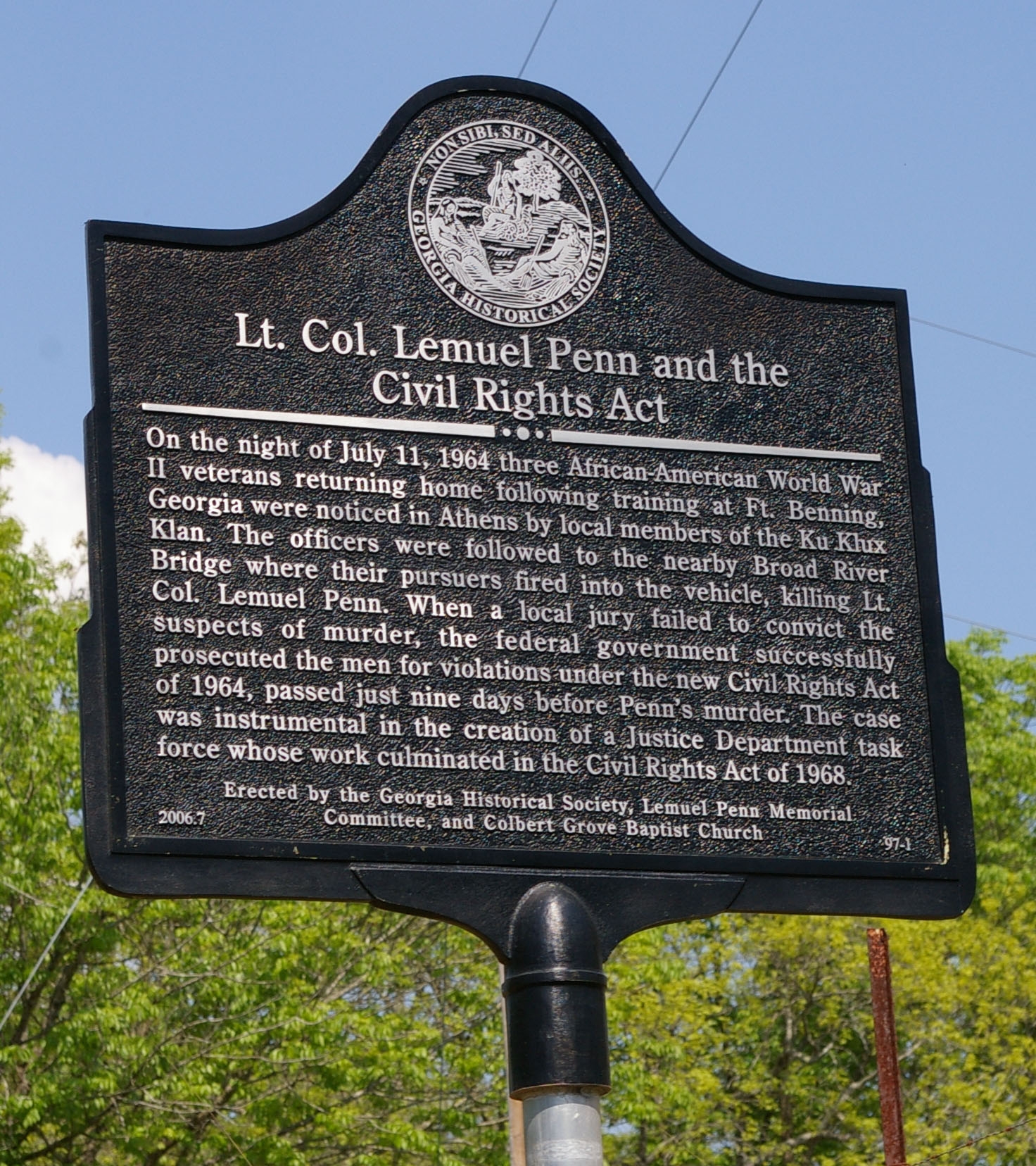
Photo by David Seibert via HMdb.org
"On the night of July 11, 1964 three African-American World War II veterans returning home following training at Ft. Benning, Georgia were noticed in Athens by local members of the Ku Klux Klan. The officers were followed to the nearby Broad River Bridge where their pursuers fired into the vehicle, killing Lt. Col. Lemuel Penn. When a local jury failed to convict the suspects of murder, the federal government successfully prosecuted the men for violations under the new Civil Rights Act of 1964, passed just nine days before Penn’s murder. The case was instrumental in the creation of a Justice Department task force whose work culminated in the Civil Rights Act of 1968."

As you likely (and correctly) surmise, the Klan was unprovoked and the jury that failed to convict was all white.

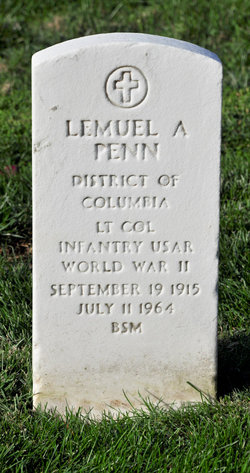
Lemuel Penn rests at Arlington Cemetery.

"NEGRO HERO
Educator Buried in Arlington

WASHINGTON (UPI) -- Lemuel Augustus Penn, Negro educator who was slain by a sniper's shotgun blast as he drove through Georgia, was buried Tuesday with full military honors at Arlington Cemetery, the nation's resting ground for its heroes...

Photo by John Evans via
FindAGrave
Penn, 48, who was in charge of the District of Columbia's five vocational high schools, was shot early Saturday morning near Athens, Ga., while returning to Washington after two weeks of reserve training at Ft. Benning, Ga...

According to the two Reserve officers accompanying Penn, the unexplained and apparently unprovoked shooting was done by a man who drove alongside their car in a rural section of the state, fired twice, then fled. Authorities assume the slaying was racially motivated.

Penn,...is survived by his wife Georgia and three children,...

During the services in the hot, crowded church, the Rev. Stanford J. Harris said Penn was a 'casualty of our battle against bigotry' and his death a reflection of the 'cancerous prejudice eating away at American democracy.'..." [Dallas Morning News (Texas), 15 July 1964, pg. 8 via GenealogyBank.]

02 February 2014

Confederate Monuments of Savannah's Forsyth Park

"The chief pleasure-ground of Savannah is Forsyth Park..."

So sayeth famed Georgia historian Lucian Lamar Knight in his 1914 publication,
Georgia's Landmarks, Memorials and Legends.


He also writes of the Confederate monuments located within the park: "On an artificial mound, in the center of the park, stands the Confederate monument, a handsome structure of brown stone, and one of the earliest memorials in Georgia dedicated to the heroes of the Lost Cause..."


"To the north of this handsome pile, is a column, perhaps five feet in height, on which rests a marble bust of Major-General Lafayette McLaws..."


"...while to the south is a similar tribute to Brigadier-General Francis S. Bartow."

01 February 2014

Monument to a Georgia Railway Pioneer, William Washington Gordon

Standing in Savannah's Wright Square (also known as Court House Square) is an impressive monument to a Georgia railway pioneer, William Washington Gordon. Here's what Lucian Lamar Knight has to say about the man and the monument:

"One of the most beautiful monuments in the city of Savannah is the handsome structure of marble, in Court House square, commemorating the useful life of the great pioneer of railway development in Georgia: William Washington Gordon. He died at the early age of forty-six. But he gave the most lasting impetus to the material upbuilding of his native State and accomplished a work of constructive value which was destined to live after him. As the first president of Georgia's earliest railway enterprise, his genius was initiative. He was not only a pathfinder but a builder of splendid highways. Much of the subsequent history of railroads in Georgia has been only the ultimate outgrowth of his pioneer activities; and if Georgia owes much to railroads then her debt of obligation to the man who inaugurated the era of railway enterprise in this State is beyond computation...

The Gordon monument in Savannah is unique. Resting upon a solid pedestal of granite, it consists of four handsome columns of Scotch marble. These enclose at the base an urn of artistic workmanship and support at the top a globe of great weight..."1

© 2010-14 S. Lincecum

William Washington Gordon, according to the monument inscription, was born 17 January 1796. He died 20 March 1842, and was buried in Savannah's Laurel Grove Cemetery.


Footnote:
1. Ancestry.com. Georgia's Landmarks, Memorials and Legends [images on-line]. Provo, UT: The Generations Network, Inc., 2005.
Original data: Knight, Lucian Lamar. Georgia's Landmarks, Memorials and Legends. Atlanta, Ga.: Printed for the author by the Byrd Print. Co., state printers, 1913-1914.

07 July 2013

Louisville Market House & the Sale of Slaves, to wit: Winn, Tartar, Cato, Frank, Maria, Chaney, Bryson, Savannah, and Vienna

Market House at Louisville, Georgia
Photo © 2013 S. Lincecum


1772 Bell

Augusta Chronicle (Georgia)
12 July 1823, pg. 2

Augusta Chronicle (Georgia)
3 December 1845, pg. 4

27 June 2013

Fort Augusta

Overlooking the Savannah River, from the rear of St. Paul's Church, stands a cross of Celtic design which marks the birth-place of the present city of Augusta. It was on this spot, at the head of navigation, that the great founder of the Colony caused a fort to be erected in 1736... (Lucian Lamar Knight, 1914)

"Fort Augusta dischar[g]ed the very highest functions for which military armaments are intended. It kept the peace throughout the whole Colonial time, up to the breaking out of the Revolution and, indeed, until 1781. It fulfilled its first purpose -- a mission of peace..." (Dr. C. C. Williams, quoted by L. L. Knight, 1914)


Photos © 2013 S. Lincecum.
Source of text: Ancestry.com. Georgia's Landmarks, Memorials and Legends [images on-line]. Provo, UT: The Generations Network, Inc., 2005.
Original data: Knight, Lucian Lamar. Georgia's Landmarks, Memorials and Legends. Atlanta, Ga.: Printed for the author by the Byrd Print. Co., state printers, 1913-1914.

22 June 2013

William C. Dawson: Grand Master of Masons in Georgia

[Originally posted at the Southern Graves blog.]

William Crosby Dawson
via Wikipedia
I headed out before the sun came up one morning several days ago to visit a few cities with roots in early Georgia history. My first stop was Greensboro, the seat of Greene County. It was first chartered in 1786, and later incorporated in 1803. I parked in front of the courthouse with every intention of walking around the back to take a peek at the old jail. Even though it was raining, I was sidetracked by a marker in front of the courthouse detailing the life of William C. Dawson. After reading it, I snapped a picture and moved on. Little did I know, I would visit Mr. Dawson again a bit later...in the cemetery, of course!

William C. Dawson marker in front of
Greene County's 1849 courthouse.
Marker reads: William C. Dawson (1798-1856), Statesman -- Soldier -- Jurist -- Freemason: "A native of Greene County, then on Georgia's Indian frontier, he was educated in the law and admitted to the bar in 1818. The remainder of his exemplary life was spent in the public service as Legislator, Captain of Volunteers in the Indian War of 1836 in Florida, Judge of the Ocmulgee Judicial Circuit, Congressman, and U.S. Senator from Georgia from 1849 to 1855.

A member and officer of historic San Marino Lodge No. 34, F & A. M. Greensboro, GA, first chartered in 1821 and which lodge has had its quarters atop the Greene County courthouse here since 1849, Brother Dawson served as Grand Master of Masons in Georgia from 1843 until his death in Greensboro on 6 May 1856. Two cities and one county in Georgia are named for him. Also named in his honor are two Masonic lodges: Dawson No. 68, F & A. M. Social Circle, GA, and Dawson No. 16, F. A. A. M. at Washington, D.C.

One of the most beloved, respected and distinguished grand masters in Georgia's long Masonic history his honored remains lie in the city cemetery near this spot. His entire life was a testimonial to his devotion to his fellowman, his country and to the sublime precepts of Freemasonry. His name will always be revered by the Freemasons of Georgia."

A short time later I was in Greensboro City cemetery, and even though I wasn't purposefully looking for it, visiting the grave of William Crosby Dawson.

WILLIAM C. DAWSON
was born on the 4th day of January, 1798,
and died on the 6th day of May, 1856.
Bred to the Bar, he entered upon his profession in
1818, and prosecuted it successfully until his death.

HE WAS AN ABLE JURIST,
an eloquent Advocate, and an upright Judge.  Cautious, practical
and independent, as a Statesman; he commanded confidence by the
frankness of his manners, the purity of his motives, and the wisdom
of his counsels.

THE STATE OF GEORGIA HONORS HIS MEMORY,
for his fidelity to her numerous trusts.
HIS NEIGHBORS CHERISH
it because he was kind and liberal to them,
AND HIS FAMILY REVERE
it because as Husband, Parent and Master, he was
affectionate, considerate, gentle and true.

Upon his death, obituaries appeared in newspapers all over the country. I read several from up and down the east coast, including Maryland and New York. The following is an example of the opening paragraph found in many. This one from South Carolina's Charleston Courier (8 May 1856, pg. 2):

"We are called on to announce the decease of one of Georgia's most honored citizens of public station and renown, and one who had worn fitly and faithfully the highest honors of the State. The Hon. William Crosby Dawson expired at an early hour on Tuesday, the 6th inst., at his residence in Greensboro, Ga., of an attack of bilious cholic."

All photos, sans the one credited to Wikipedia, are © 2013 S. Lincecum.