11 June 2014

Lester Cemetery in Elko

Many, many moons ago, I received a listing of burials at Lester Cemetery in Elko, Houston County, Georgia. I had them online with one of the county projects, but it was subsequently removed when I changed things over on my website.

Cover page I received with list.

I just finished putting all the burials (that weren't already there) on FindAGrave.  Give it a search, if you'd like.  Surnames include:
Brown, Burke, Cobb, Cosby, Crowd, Dyer, Jackson, Lester, Malcolm, McNair, Perry, Thomas, Vance


Search for cemetery records in Lester Family Cemetery, GA at by entering a surname and clicking search:

Restrict search to

Surname

10 June 2014

Swallowing Hairpins Caused Death of Girl

Simply an obituary I felt compelled to share:
SWALLOWING HAIRPINS CAUSED DEATH OF GIRL
Savannah, Ga., April 24 -- (Special.) -- Katie Tuiseda, a Polish girl, who was found ill wandering about the union station several weeks ago, is dead, as the result of blood poisoning caused by a number of wire hairpins which the young woman swallowed. She had twisted the hairpins up, but after they were in her stomach, they had straightened out and began working their way out of her body through her sides. She suffered in silence, refusing to tell physicians of the pins until when they began to protrude they were discovered. An operation was performed, but the young woman's life could not be saved. Nothing is known of her people, and she was given a pauper's burial. [Atlanta Constitution (Georgia), 25 April 1908]

18 February 2014

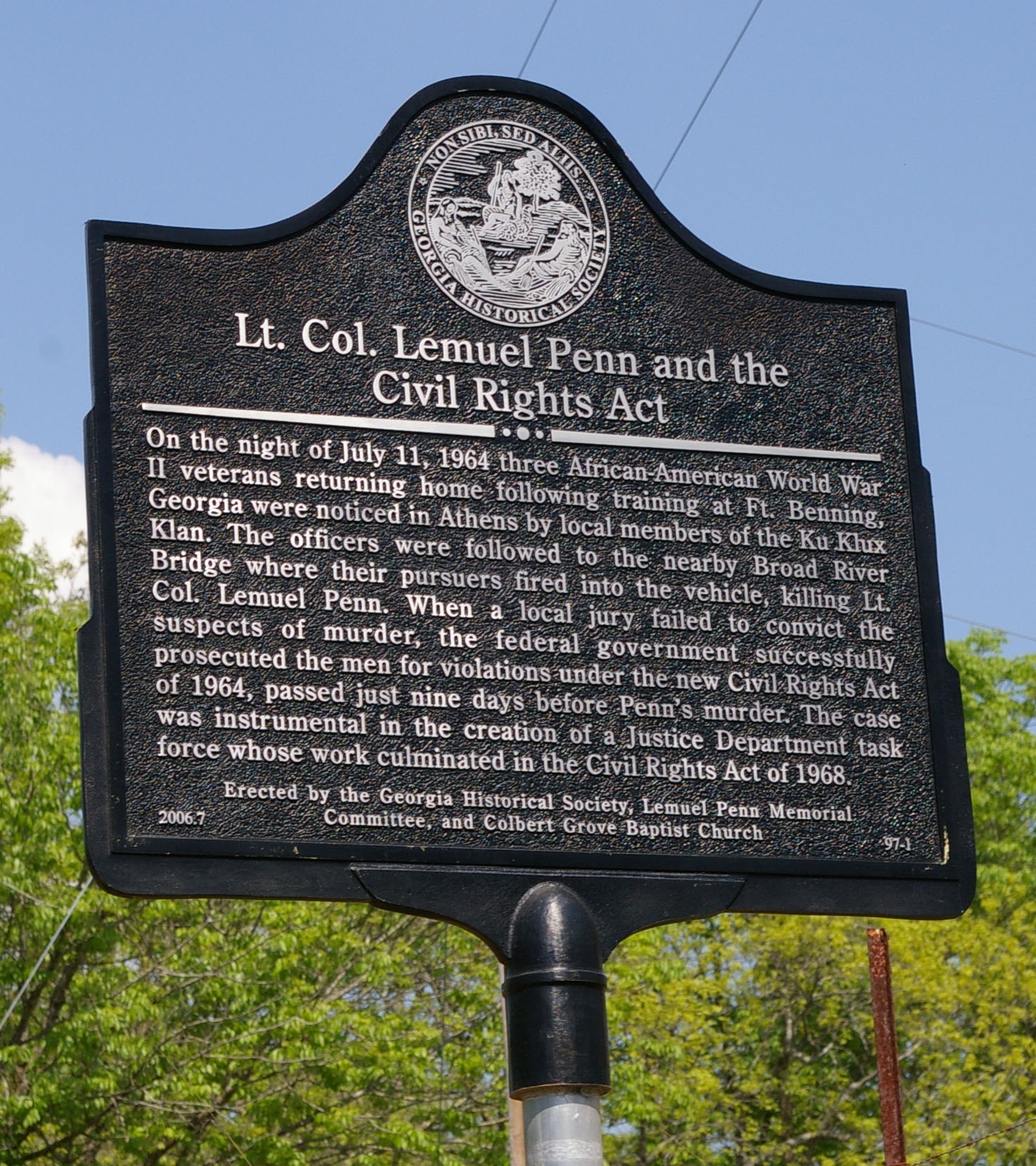
Lemuel Penn and the Civil Rights Act (Tombstone Tuesday)

Here's a piece of Georgia history of which I was unaware. (Originally posted at the Southern Graves blog.)

Photo by David Seibert via HMdb.org
"On the night of July 11, 1964 three African-American World War II veterans returning home following training at Ft. Benning, Georgia were noticed in Athens by local members of the Ku Klux Klan. The officers were followed to the nearby Broad River Bridge where their pursuers fired into the vehicle, killing Lt. Col. Lemuel Penn. When a local jury failed to convict the suspects of murder, the federal government successfully prosecuted the men for violations under the new Civil Rights Act of 1964, passed just nine days before Penn’s murder. The case was instrumental in the creation of a Justice Department task force whose work culminated in the Civil Rights Act of 1968."

As you likely (and correctly) surmise, the Klan was unprovoked and the jury that failed to convict was all white.

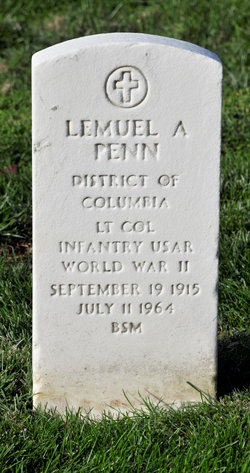
Lemuel Penn rests at Arlington Cemetery.

"NEGRO HERO
Educator Buried in Arlington

WASHINGTON (UPI) -- Lemuel Augustus Penn, Negro educator who was slain by a sniper's shotgun blast as he drove through Georgia, was buried Tuesday with full military honors at Arlington Cemetery, the nation's resting ground for its heroes...

Photo by John Evans via
FindAGrave
Penn, 48, who was in charge of the District of Columbia's five vocational high schools, was shot early Saturday morning near Athens, Ga., while returning to Washington after two weeks of reserve training at Ft. Benning, Ga...

According to the two Reserve officers accompanying Penn, the unexplained and apparently unprovoked shooting was done by a man who drove alongside their car in a rural section of the state, fired twice, then fled. Authorities assume the slaying was racially motivated.

Penn,...is survived by his wife Georgia and three children,...

During the services in the hot, crowded church, the Rev. Stanford J. Harris said Penn was a 'casualty of our battle against bigotry' and his death a reflection of the 'cancerous prejudice eating away at American democracy.'..." [Dallas Morning News (Texas), 15 July 1964, pg. 8 via GenealogyBank.]

02 February 2014

Confederate Monuments of Savannah's Forsyth Park

"The chief pleasure-ground of Savannah is Forsyth Park..."

So sayeth famed Georgia historian Lucian Lamar Knight in his 1914 publication,
Georgia's Landmarks, Memorials and Legends.


He also writes of the Confederate monuments located within the park: "On an artificial mound, in the center of the park, stands the Confederate monument, a handsome structure of brown stone, and one of the earliest memorials in Georgia dedicated to the heroes of the Lost Cause..."


"To the north of this handsome pile, is a column, perhaps five feet in height, on which rests a marble bust of Major-General Lafayette McLaws..."


"...while to the south is a similar tribute to Brigadier-General Francis S. Bartow."

01 February 2014

Monument to a Georgia Railway Pioneer, William Washington Gordon

Standing in Savannah's Wright Square (also known as Court House Square) is an impressive monument to a Georgia railway pioneer, William Washington Gordon. Here's what Lucian Lamar Knight has to say about the man and the monument:

"One of the most beautiful monuments in the city of Savannah is the handsome structure of marble, in Court House square, commemorating the useful life of the great pioneer of railway development in Georgia: William Washington Gordon. He died at the early age of forty-six. But he gave the most lasting impetus to the material upbuilding of his native State and accomplished a work of constructive value which was destined to live after him. As the first president of Georgia's earliest railway enterprise, his genius was initiative. He was not only a pathfinder but a builder of splendid highways. Much of the subsequent history of railroads in Georgia has been only the ultimate outgrowth of his pioneer activities; and if Georgia owes much to railroads then her debt of obligation to the man who inaugurated the era of railway enterprise in this State is beyond computation...

The Gordon monument in Savannah is unique. Resting upon a solid pedestal of granite, it consists of four handsome columns of Scotch marble. These enclose at the base an urn of artistic workmanship and support at the top a globe of great weight..."1

© 2010-14 S. Lincecum

William Washington Gordon, according to the monument inscription, was born 17 January 1796. He died 20 March 1842, and was buried in Savannah's Laurel Grove Cemetery.


Footnote:
1. Ancestry.com. Georgia's Landmarks, Memorials and Legends [images on-line]. Provo, UT: The Generations Network, Inc., 2005.
Original data: Knight, Lucian Lamar. Georgia's Landmarks, Memorials and Legends. Atlanta, Ga.: Printed for the author by the Byrd Print. Co., state printers, 1913-1914.

07 July 2013

Louisville Market House & the Sale of Slaves, to wit: Winn, Tartar, Cato, Frank, Maria, Chaney, Bryson, Savannah, and Vienna

Market House at Louisville, Georgia
Photo © 2013 S. Lincecum


1772 Bell

Augusta Chronicle (Georgia)
12 July 1823, pg. 2

Augusta Chronicle (Georgia)
3 December 1845, pg. 4

27 June 2013

Fort Augusta

Overlooking the Savannah River, from the rear of St. Paul's Church, stands a cross of Celtic design which marks the birth-place of the present city of Augusta. It was on this spot, at the head of navigation, that the great founder of the Colony caused a fort to be erected in 1736... (Lucian Lamar Knight, 1914)

"Fort Augusta dischar[g]ed the very highest functions for which military armaments are intended. It kept the peace throughout the whole Colonial time, up to the breaking out of the Revolution and, indeed, until 1781. It fulfilled its first purpose -- a mission of peace..." (Dr. C. C. Williams, quoted by L. L. Knight, 1914)


Photos © 2013 S. Lincecum.
Source of text: Ancestry.com. Georgia's Landmarks, Memorials and Legends [images on-line]. Provo, UT: The Generations Network, Inc., 2005.
Original data: Knight, Lucian Lamar. Georgia's Landmarks, Memorials and Legends. Atlanta, Ga.: Printed for the author by the Byrd Print. Co., state printers, 1913-1914.

22 June 2013

William C. Dawson: Grand Master of Masons in Georgia

[Originally posted at the Southern Graves blog.]

William Crosby Dawson
via Wikipedia
I headed out before the sun came up one morning several days ago to visit a few cities with roots in early Georgia history. My first stop was Greensboro, the seat of Greene County. It was first chartered in 1786, and later incorporated in 1803. I parked in front of the courthouse with every intention of walking around the back to take a peek at the old jail. Even though it was raining, I was sidetracked by a marker in front of the courthouse detailing the life of William C. Dawson. After reading it, I snapped a picture and moved on. Little did I know, I would visit Mr. Dawson again a bit later...in the cemetery, of course!

William C. Dawson marker in front of
Greene County's 1849 courthouse.
Marker reads: William C. Dawson (1798-1856), Statesman -- Soldier -- Jurist -- Freemason: "A native of Greene County, then on Georgia's Indian frontier, he was educated in the law and admitted to the bar in 1818. The remainder of his exemplary life was spent in the public service as Legislator, Captain of Volunteers in the Indian War of 1836 in Florida, Judge of the Ocmulgee Judicial Circuit, Congressman, and U.S. Senator from Georgia from 1849 to 1855.

A member and officer of historic San Marino Lodge No. 34, F & A. M. Greensboro, GA, first chartered in 1821 and which lodge has had its quarters atop the Greene County courthouse here since 1849, Brother Dawson served as Grand Master of Masons in Georgia from 1843 until his death in Greensboro on 6 May 1856. Two cities and one county in Georgia are named for him. Also named in his honor are two Masonic lodges: Dawson No. 68, F & A. M. Social Circle, GA, and Dawson No. 16, F. A. A. M. at Washington, D.C.

One of the most beloved, respected and distinguished grand masters in Georgia's long Masonic history his honored remains lie in the city cemetery near this spot. His entire life was a testimonial to his devotion to his fellowman, his country and to the sublime precepts of Freemasonry. His name will always be revered by the Freemasons of Georgia."

A short time later I was in Greensboro City cemetery, and even though I wasn't purposefully looking for it, visiting the grave of William Crosby Dawson.

WILLIAM C. DAWSON
was born on the 4th day of January, 1798,
and died on the 6th day of May, 1856.
Bred to the Bar, he entered upon his profession in
1818, and prosecuted it successfully until his death.

HE WAS AN ABLE JURIST,
an eloquent Advocate, and an upright Judge.  Cautious, practical
and independent, as a Statesman; he commanded confidence by the
frankness of his manners, the purity of his motives, and the wisdom
of his counsels.

THE STATE OF GEORGIA HONORS HIS MEMORY,
for his fidelity to her numerous trusts.
HIS NEIGHBORS CHERISH
it because he was kind and liberal to them,
AND HIS FAMILY REVERE
it because as Husband, Parent and Master, he was
affectionate, considerate, gentle and true.

Upon his death, obituaries appeared in newspapers all over the country. I read several from up and down the east coast, including Maryland and New York. The following is an example of the opening paragraph found in many. This one from South Carolina's Charleston Courier (8 May 1856, pg. 2):

"We are called on to announce the decease of one of Georgia's most honored citizens of public station and renown, and one who had worn fitly and faithfully the highest honors of the State. The Hon. William Crosby Dawson expired at an early hour on Tuesday, the 6th inst., at his residence in Greensboro, Ga., of an attack of bilious cholic."

All photos, sans the one credited to Wikipedia, are © 2013 S. Lincecum.

11 June 2013

Review: Georgia Courthouse Disasters by Paul Graham

It's an indispensable book. It really is.

I first caught wind of Paul K. Graham's Georgia Courthouse Disasters via an article at the Legal Genealogist blog. She was quite persuasive, so I bought it. Turns out she was pretty accurate in her assessment, too. ;-)

Georgia Courthouse Disasters provides a listing of the more than 100 "events" that resulted in some sort of damage to courthouses and had an impact on the 159 counties in Georgia. There is an alphabetical list as well as a chronological list. From the Introduction:
Previously, cursory lists only gave a hint of destructive events and potential loss of records. None were complete, and many included dates of planned demolitions or "fires" that never happened. Through careful research, each event has now been documented using contemporary evidence. If a courthouse disaster does not appear in this book, no evidence was found during the research process.
Then each county with a disaster has a separate mention with a description of the disastrous event and source citations.

Not every courthouse had a disaster, mind you. But, as you well know, county boundaries changed over time. Parts of some counties were used to create other counties. Some counties were consolidated. Not to mention, Georgia has the second most number of counties behind only Texas. [per Wikipedia] So Mr. Graham does something that I think ranks this resource above any other attempted past listing -- he provides maps! A modern county map is used with a shaded boundary showing the maximum impact of loss, as well as another bold outline of limited impact. For example, let's take the county of Washington. The map shows the maximum impact being said county, as expected, but take a look at the number of (modern day) counties with limited impact: Oglethorpe, Greene, Taliaferro, Hancock, Baldwin, Jefferson, Johnson, Laurens, Treutlen, Emanuel, Jenkins, Montgomery, Toombs, Candler, and Tattnall. Fifteen! I have ancestors in some of those counties, and never looked at Washington's issue quite that way.

I told you it was indispensable.

At only $5.39 per paperback (at Amazon), the value totally surpasses (IMHO) the modest price.

But it gets better (also, IMHO).

I have been going through a self-imposed season of downsizing and minimizing. And though I usually purchase my reference books in their "old-fashioned" bound form, I thought this one might be an easy one to try on my Kindle. And I'm thrilled with the result. It takes up no space on my physical bookshelf, and is available to me anywhere (online and off). With all of the Kindle reading apps, the book is literally at my fingertips -- on my desktop PC, on my laptop, on my netbook, on both of my Kindles, and on my iTouch. Furthermore, with a linked table of contents and just a couple of clicks or taps, I can be at the county of interest in mere seconds. The price of this wealth of knowledge and convenience? $2.99 -- I say get 'em while their hot!

30 May 2013

Parrish Brothers of Berrien County, Georgia

I would be thrilled to find a description of one of my ancestors in a history book, let alone a set of seven! The following is from Lucian Lamar Knight's Georgia's Landmarks, Memorials and Legends (pg. 303, pub. 1914).
The Parrish family of Berrien holds a somewhat unique record. Seven sons of the Rev. Ansel Parriash, an itinerant Methodist minister, represent an aggregate weight of 1,568 pounds, or an average weight of 224 pounds each. They recently held a family reunion at the home of Mr. J. A. J. Parrish, of Adel, at which time the scales were brought into use, showing the weight of the brothers to be as follows: J. W. Parrish, of Adel, 308 pounds; E. C. Parrish, of Adel, 229 pounds; A. B. Parrish of Savannah, 221 pounds; J. A. Parrish, of Adel, 218 pounds; J. W. Parrish, of Lois, 209 pounds; H. W. Parrish, of Sparks 202 pounds; and J. A. B. Parrish of Valdosta, 181 pounds...not a single member of the family has ever known a serious illness. With ages ranging at present from 42 to 63 years, they are vigorous, energetic, industrious men, showing no signs of corpulent or surplus flesh, engaged in widely different occupations, well-esteemed, prosperous, intelligent and high-minded men. It is a custom of the brothers to hold a family reunion each year in the month of February; and no matter how far from home this season of the year finds them or on what business intent, they always return for these festive gatherings.

Image Credit: VintageKin.com

29 May 2013

Do You Know the Ryman Auditorium was Built for a Georgia Preacher?

[I certainly did not until recently! The following was originally posted at the Southern Graves blog.]

Sam P. Jones
Mentally heroic, magnetic to a degree which drew all men to him, physically and morally a man militant and unafraid, Sam P. Jones was known to thousands in all parts of this country. [1906]

But I had never heard of Rev. Jones before arriving at his draped obelisk at Oak Hill Cemetery in Cartersville, GA the spring of 2011. And still didn't think much of him until learning he was the reason Nashville's famed Ryman Auditorium was built. Yes, the home of the Grand Ol' Opry. That Ryman Auditorium. A little factoid such as that will make this fan of country music dig a little deeper.

Photo © 2011-2013 S. Lincecum

The story goes that Samuel Porter Jones, born 16 October 1847, was quite the whiskey drinker. It ruined his law career and strained familial relationships. He even described himself as "the wickedest young man in Georgia," and further stated: "I was going to hell a mile a minute when I stopped and went the other way." That turnabout came on the deathbed of his father in 1872. Sam P. Jones never looked back, becoming one of the most well-known evangelists and revival preachers in the United States.

One of the things Rev. Jones was known for was his epigrams. Here are a few:

"The devil can run a mile while the church is putting on its boots."

"Deathbed repentance is the retreat of a coward and an insult to God."

"I hate theology and botany; I love religion and flowers."

"The tune of America is pitched to the dollar."

Ryman Auditorium
from Wikimedia Commons
Reason for the Ryman
On 10 May 1885 Thomas Ryman, owner of several saloons, hears Rev. Samuel P. Jones speak: "According to legend, Thomas Ryman was fed up with Sam Jones' preaching against drinking and gambling, so he and a few friends went to Jones' tent revival to raise a ruckus. But something in Jones' speech affected Ryman so deeply that he repented his sins and vowed to build Jones a great tabernacle so that he would never again have to preach under a tent again in Nashville. Ryman became wholly focused on the construction of the Union Gospel Tabernacle which would later be renamed the Ryman Auditorium in his honor." [Ryman.com]

Rev. Sam P. Jones died 15 October 1906, the day before his 59th birthday, near Little Rock, Arkansas. He had just completed a preaching stint at a revival in Oklahoma, and was on a train bound for his home in Cartersville, preparing to celebrate his birthday with a family reunion.

Prior to his funeral in Cartersville, Jones' body lay in state at the capitol rotunda in Atlanta. The day and atmosphere surrounding his funeral was described in the Biloxi Daily Herald (Mississippi), 20 October 1906:
"Living, the Rev. Sam P. Jones was loved with a tenderness that one sees but once in a life time. Wrapped in the cold arms of death, this love was given an expression which was confined to no class or condition, no age, color or sex.

Cartersville, where Sam Jones was best known, by reason of the fact that it was his home, seemed paralyzed by paroxysms of grief which followed one another in quick succession whenever the name of the dead evangelist was mentioned or when some familiar object reminiscent of his was seen.

Even nature was in accord with the grief of the city. The sky was overcast with banks of dull, threatening clouds, which seemed at any moment ready to turn loose the full flood of their sorrow. Cartersville had the silence of the sepulchre during the entire day...Religions for the once were as one...Knots of people congregated at each corner, and Caucasian and negro freely fraternized, their common grief being a bond which brought all together and for the time obliterated all barriers."
This is a long winded post, I know. But I must note that Rev. Sam P. Jones of course had his detractors. And the following article from the 17 October 1906 Jonesboro Evening Sun (Arkansas) seemed to sum "things" up nicely:

Rev. Sam P. Jones
Born Oct 16, 1847
Died Oct 15, 1906
"They that turn many to righteousness shall shine as the
stars for ever and ever." -- Daniel 12, 3.
"SAM JONES.
The only Sam Jones is dead, and with his death one of the most unique characters in the later times passes from the stage of action. It is not difficult to estimate a character like Sam Jones. His work was so individual, and stands out in such well defined proportion that it may be viewed with definite entirety.

No sooner does a great man die than the world hastily takes account of its loss -- that perhaps, being the world's selfish way of showing its appreciation -- and in the death of Sam Jones the loss is large. The first thought of those who regret the material loss of his work might be that it is fortunate he lived so long.

There are those who did not admire Sam Jones and his methods. They were not exactly canonical. And the host of imitators who succeeded only in impressing the fact that they were imitators, is one of the results of Sam Jones' not edifying but for which he could not be held to account. But good resulted from his work and in generous proportion. His galling satire reached many a hardened sinner, who repented because he admired the manner in which he was called to account."

15 May 2013

Centuries Have Not Dimmed the Glory

..."Surmounting a pedestal of granite, the figure of Sergeant Jasper, heroic in size and wrought of bronze, is portrayed in the act of seizing the colors of his regiment. It reproduces the heroic scene of his martyrdom, on the Spring Hill redoubt, during the siege of Savannah. With the flag in one hand, he raises his gallant sword with the other, to defend the emblem of his country's liberties." 1

The monument to Sgt. William Jasper, unveiled in 1888, stands in Savannah, Georgia's Madison Square. It is inscribed:

To The Heroic Memory Of
Sergeant William Jasper
Who Though Mortally Wounded
Rescued The Colors Of His Regiment
In The Assault
On The British Lines About This City
October 9th, 1779
A Century Has Not Dimmed The Glory
Of The Irish American Soldier
Whose Last Tribute To Civil Liberty
Was His Noble Life
1779 - 1879


All photos © 2010-2013 S. Lincecum.

More about William Jasper from Wikipedia.

Footnote:

1. Ancestry.com. Georgia's Landmarks, Memorials and Legends [images on-line]. Provo, UT: The Generations Network, Inc., 2005.
Original data: Knight, Lucian Lamar. Georgia's Landmarks, Memorials and Legends. Atlanta, Ga.: Printed for the author by the Byrd Print. Co., state printers, 1913-1914.

10 May 2013

About Andrew Bryan, Noted Negro Preacher (A Friend of Friends Friday)

From Georgia's Landmarks, Memorials, and Legends by Lucian Lamar Knight, page 95:
Caesar, one of the numerous slaves owned by Jonathan Bryan, lived to be a centenarian. But long before his death he was made a free man by the voluntary act of his master. Andrew, a son of the old ex-slave, became a noted negro preacher of Savannah during the early ante-bellum period. The following brief items, copied from the records, tell a story of some interest. First, the death notice of Jonathan Bryan's faithful servant Caesar. This reads as follows: "Nov. 27th, 1798. Savannah, Ga. Died at the plantation of Col. Wylly [son-in-law of the late Hon. Jonathan Bryan] aged 103 years, negro Caesar, father of the celebrated Parson Andrew. Caesar was a faithful servant of the late Jonathan Bryan, Esq., for forty-two years, when he gave him his freedom." -- In Book B. Chatham County Records, pp, 213, 214, dated May 4th, 1789, will be found an entry showing where William Bryan, planter, son of Jonathan Bryan, sets free Andrew, a former slave on the estate of Jonathan Bryan and by division of estate, William Bryan's slave. -- In Book N. Chatham County Records, p. 117, dated Sept. 4th, 1773, there is an entry showing where a plot of ground at Yamacraw in what was then called the village of St. Gall was deeded to William Bryan and James Whitefield, in trust for a black man, named Andrew Bryan, a preacher of the gospel. The consideration involved was thirty pounds sterling. On this plot of ground was built the negro church of which Andrew Bryan was the pastor until his death. As an item of interest for the future historian, this fragment illustrative of life under the old feudal regime at the South is worthy of preservation.

07 May 2013

The Mother Church of Georgia & Washington's Southern Tour

Photo © 2010-2013 S. Lincecum
"On the original spot where the Colonists established a house of worship stands today the beautiful and classic proportions of Christ Church. Here Wesley preached and Whitefield exhorted -- the most gifted and erratic characters in the early settlement of Georgia." 1

The edifice from 1838 stated the church building, founded in 1743, was destroyed by fire in 1796. After rebuilding, it was partially destroyed by a hurricane in 1804. It was later added that the church was again partially destroyed by fire, and the current structure was a rebuilding and improvement dating to 1897. The historical marker in Savannah's Johnson Square details this as the "current and third structure" designed by James Hamilton Couper.

Early and noteworthy members of the parish include William Scarborough, who built the first steamship to cross the Atlantic Ocean; Dr. Theodosius Bartow, father of Col. Francis S. Bartow; Dr. George Jones, a U.S. senator; and R. R. Cuyler, a famous railroad pioneer.

George Washington attended services in the original Christ Church 15 May 1791.


Footnote:

1. Pleasant A. Stovall, as quoted by Lucian Lamar Knight in Georgia's Landmarks, Memorials and Legends (pub. 1914).

20 April 2013

Oglethorpe Monument in Savannah's Chippewa Square

Pride and gratitude have always mingled in the emotions with which Georgia has contemplated the career and cherished the name of Oglethorpe; but almost two centuries elapsed before an adequate monument to the great humanitarian was reared in the city which he founded. At last, under bright skies, on November 23, 1910, in the city of Savannah, a superb bronze statue surmounting a pedestal of granite, was unveiled in Chippewa Square.1

...the Great Soldier, Eminent Statesman, and Famous
Philanthropist, General James Edward Oglethorpe, who, in
this city, on the 12th day of February, A.D., 1733, founded
and established the Colony of Georgia. 
One of four lions holding shields at base of monument.
This shield bears the Georgia State Seal.
All photos © 2010-2013 S. Lincecum


Footnote:

1. Ancestry.com. Georgia's Landmarks, Memorials and Legends [images on-line]. Provo, UT: The Generations Network, Inc., 2005.
Original data: Knight, Lucian Lamar. Georgia's Landmarks, Memorials and Legends. Atlanta, Ga.: Printed for the author by the Byrd Print. Co., state printers, 1913-1914.

19 April 2013

The Capture of Jefferson Davis

Two miles to the west of Irwinville, in what is today a dense thicket of pines, there occurred at the the close of the Civil War an incident concerning which a host of writers have produced for commercial purposes an endless amount of fiction.

...That is how Lucian Lamar Knight began his chapter on the capture of Jefferson Davis in his 1913 publication of Georgia's Landmarks, Memorials and Legends. The thicket is not quite as dense today, but you can still get a feel of how things were. And some might recall the gossip surrounding the incident, as it most certainly has continued to be passed down over the last 148 years, one of the most common bits being that Davis was captured while wearing women's clothing.

Mr. Knight refutes this in his writing by way of Mr. James H. Parker, a Federal soldier who witnessed the arrest, who stated:

"I am no admirer of Jeff Davis. I am a Yankee, full of Yankee prejudice; but I think it wicked to lie about him or even about the devil. He did not have on at the time he was taken any such garment as is worn by women. He did have over his shoulders a waterproof article of clothing, something like a Havelock. It was not in the least concealed. He wore a hat and did not carry a pail of water on his head."

Mr. Knight also cited T. H. Peabody, one of the captors of Mr. Davis, as saying that the "hoop-skirt story was purely a fabrication of newspaper reporters."


Jefferson Davis Memorial Historic Site
338 Jeff Davis Park Rd
Fitzgerald, GA

Photos © 2010-2013 S. Lincecum

17 April 2013

An Important Piece of the Story?

I saw this little news item and thought it might be an important piece to someone's family history, so here it is:

The Constitution (Atlanta, Georgia)
3 February 1910
(Digital image viewed online at Ancestry.)
CHILDREN WEEP BITTERLY WHEN AWARDED TO FATHER
Savannah, Ga., February 2. -- (Special.) -- Judge Davis Freeman today awarded four of five children to John M. Lubeck, but gave the fifth to Miss Lillie Dotson, their aunt, because the mother of the children before her death had expressed a desire that the eldest child should go to her sister.

Judge Freeman, however, required her to promise that no whisky or gin should be given the boy, as had been done in the past.

After this disposition was made of a case that has run for three days in the city court, two of the smaller children wept bitterly when they learned their father had won them from their aunt, and one little boy ran to a cab that was waiting for them, grasped the whip and announced he would fight before his father should have him. He was pacified.

07 April 2013

An Instance of Wifely Devotion Unprecedented in the History of Georgia

The Constitution (Atlanta, Georgia)
2 October 1892

TOGETHER STILL

Are Man and Wife, Though the Husband is Dead.

A SENSATIONAL STORY FROM CORDELE

Which Involves One of the Leading and Best Known Families.

A GLASS COFFIN IN A PARLOR

Is the Mausoleum of Dr. Marvin, the Late Mayor -- He Once Lived in Atlanta and was Well Known Here


A ghastly, thrilling story comes from Cordele, that progressive, thriving town down in Dooly.

So ghastly and blood-curdling is the story that many who hear are not inclined to believe it, while those who do believe it shudder when they hear it hinted.

The central figures in the story are well known in Atlanta, where they resided until a few years ago.

And both will be readily recalled by Atlantians -- those especially who were accustomed to traversing Whitehall street.

Whitehall Street, Atlanta
J. L. Schaub, Photographer [Public domain],
via Wikimedia Commons
Three years ago Dr. George W. Marvin was one of Atlanta's best known citizens. On the streets he was a well-known character, and when once seen never forgotten. For years he and his wife had lived on Whitehall street near Smith street, and there was hardly an afternoon when the weather was pleasant that they could not be seen promenading the sidewalk, sitting upon their spacious veranda or lounging around in the beautiful flower garden in front of the pleasant, happy home.

Down town the doctor was well known and by those with whom he came in contact he was liked. He was a gentleman of scrupulous neatness and apparently gave much time to his toilet. His clothing was always of the latest style and more than ordinary taste was displayed in his selections. He was not above the average size, but the immense side whiskers and heavy, drooping mustache he wore gave him something of a distinguished look. He seemed to pride himself on his personal appearance and would shun a speck of flying dust as quickly as he would dodge a mud-bedaubed buggy wheel casting off its load.

Dr. Marvin was not only partial to neat clothing, but he was especially fond of handsome jewelry. He wore a magnificent cluster of diamonds on his short front while an extra inlet was made in the linen to accommodate the fourth large diamond stud. His fingers were bedecked with the same shining stones and it was the boast of the doctor that he wore a limited fortune around with him -- a fortune any pawnbroker would gladly gather.

Dr. Marvin was abundantly able to enjoy the luxury of the diamond display. His tax returns were not at all small and his check, annually given the city, was quite a sum. On Whitehall street he owned several residences, while Smith street owes many of its pretty cottage homes to the doctor's spirit of improvement. On Marietta street he owns two or three stores, while other business houses in other parts of the city were charged to him on the assessor's books.

A few years ago, Cordele, in Dooly county, sprang up and Dr. Marvin's judgement caused him to go there and invest. He quickly became a prominent citizen and besides being elected president of the Cordele Bank was made mayor of the thriving city. There he carried with him a large gold-headed cane which all of his Atlanta friends knew.

A few months ago Atlantians were astonished to hear that Dr. Marvin was dead, but in a short time he was forgotten. A day or two ago a well-known Cordelean came to Atlanta and in talking with one of Dr. Marvin's old friends remarked:

"It's funny that he was never buried."

"Never buried!" said the Atlantian in surprise, "what do you mean?"

The Cordelean thought the Atlantian knew it all, but when he found that he did not, said:

"Well, Dr. Marvin's body is in a glass coffin in his wife's parlor. Through that coffin you can see him just as you used to see him here on the streets. He is dressed in that same faultless style, and has on all those brilliant diamonds. In his hand is that same gold-headed cane."

"When the doctor died Mrs. Marvin was going to bury him just as he is now; but some one told her that the grave would be too big a temptation and the jewelry would be stolen by grave robbers. Then she sent to New Orleans for an undertaker and had the body thoroughly embalmed, placed in a glass coffin and it is now in her parlor. That New Orleans undertaker contracted blood poison and had to have part of his hand amputated."

The Constitution's correspondent at Cordele was asked about the story, so unusual it was, last night, and here is his reply:

The Story From Cordele

Cordele, GA, October 1 -- Special -- Cordele furnishes an instance of wifely devotion unprecedented in the history of Georgia and unsurpassed by the fabled goddess.

This is a broad assertion but the story of Mrs. George W. Marvin, wife of the late mayor of Cordele, will bear me out fully in making it.

On the 10th day of July of this year Dr. Marvin saw the last of this world surrounded by his wife and friend who attended him through a long illness and his crushed and heart-broken wife. Those who witnessed the scene say they have never seen anything more thrilling and touching. Mrs. Marvin lost complete control of her nerves and raved furiously. She refused to be comforted by her friends, and as she had no belief in a hereafter she could gain no relief from the grace of him who giveth all things and taketh all things away.

She made the startling announcement then and there, that she had made a solemn compact with her husband before his death, agreeing that they would both enter oblivion at as near the same time as could be easily arranged by means of suicide. Those who were with Mrs. Marvin at the time thought of course that when the excitement caused by Dr. Marvin's death wore off, she would forget her threats of self-inflicted death and take up the weary cares of life again with peaceful resignation.

It seems now, however, that the assertion that she intended to kill herself, was the announcement of a fixed determination, and she still contemplates taking her own life as soon as she has made some arrangements for the permanent interment of her husband's remains, for the reader must understand that at this moment all that is mortal of Dr. George W. Marvin occupies a place in the late residence of that gentleman and the present residence of his widow.

An embalmer from Macon was telegraphed for immediately, upon the death of Dr. Marvin and his body was prepared for burial.

The funeral and procession was nearly a mile long, and all the business houses in Cordele were closed, showing universal respect for the man who had added so much to the city's prosperity.

But the sensational features of the situation were only begun.

For four days the body lay in the ground and the people were beginning to forget the excitement attending his death and burial.

In the darkness of a quiet night there was another funeral procession, but no carriages followed the hearse and no one on foot accompanied the dead except those who helped to dig the earth from above the coffin and bear the corpse back to the place from which the first procession had started.

In the dead of the night a few trusted friends, whom Mrs. Marvin had requested to act, went to the cemetery and brought back the body.

Next morning Mr. W. D. Alverson, a young embalmer, arrived from New Orleans, and at once began the process of embalming the body so that it could be preserved indefinitely. At the same time an Italian sculptor, who now resides in Augusta, arrived and began preparing plans for an immense mausoleum to be erected in Cordele in memory of Dr. Marvin.

The artist submitted a plan of a monument which would be a pride to any city and if the original idea had been carried out this city would have had the most magnificent tomb in Georgia. The design was of a monument to consist of a room as a base with at each corner a second set of columns of the tomb and capped with a shaft, the whole to tower in the sir sixty-six feet.

It would have cost when completed $32,000.

Mrs. Marvin intended placing Dr. Marvin's body in this tomb and then killing herself, leaving the whole of her wealth, which is estimated at over one hundred and fifty thousand dollars, as an endowment to sustain a park around the monument.

But she has given up the idea of building this tomb and substituted the building of a college as a living monument to her husband's memory.

In the meantime, the body is kept in her house on Ninth avenue.

It lies in a handsome metallic casket and on a beautiful silver plate on the lid is inscribed:

"Dr. George W. Marvin, Cordele, Ga. Died July 10, 1892."

The room is darkened and the key is entrusted to Mr. Goodrich, a gentleman who has proven himself as one of Mrs. Marvin's best friends in her hours of trouble.

She now is living with her Miss Mamie Tramnell, a cousin from Meriwether county.

Mrs. Marvin proposes to erect a magnificent college of music and endow it with her total estate. She expresses her full determination to kill herself as soon as these arrangements have been made. It is a most remarkable case in the history of Dooly county and the people from the country never ceased to worry Mrs. Marvin to see the doctor's corpse, which she, of course, refuses indignantly.