Showing posts with label Civil Rights. Show all posts

10 February 2018

Blood at the Root: a Racial Cleansing in America (Book Review)

Title:  Blood at the Root: a Racial Cleansing in America
Author: Patrick Phillips
Publication: 2016, W. W. Norton Company
Hardcover noted as having 320 pages. I read the Kindle edition.
Short Synopsis: In the fall of 1912, the entire African American community of Forsyth County, Georgia was literally run out of and banished from the county by the white population. An all-white county remained for decades, even close to a century. The book explores why and how this happened. It's a dark read, but one that is important (I believe) for the citizens of the United States, even to this day.

What Happened

In early September 1912, nineteen-year-old Mae Crow, who had been missing, was found in the woods of Forsyth County, Georgia.  This daughter of well-known citizens of Oscarville, Leonidas Alonzo and Azzie Jane Bennett Crow, had been savagely beaten and left for dead.

The next day, the Forsyth County sheriff arrested three young African Americans:  Rob Edwards, age 24; Oscar Daniel, age 18; and Ernest Knox, age 16.  Rob Edwards didn't stand a chance.  He was almost immediately lynched – killed without due process.

Image by B. McDowell
via FindAGrave
On 23 September 1912, Mae Crow – "one of the most beautiful girls in all of Forsyth" – died from her injuries.  When nightfall came after her funeral, "all hell broke loose in Forsyth County." Groups of white men on horseback – night riders – went into the African American community and told them to get out of the county, "or stay and die like Rob Edwards." The night riders used whatever means were necessary, including "posted notices, scrawled letters, rifles, torches, and sticks of dynamite."
By the end of October, the night riders had forced out all but a handful of the 1,098 members of the African American community – who left in their wake abandoned homes and schools, stores and livestock, and harvest-ready crops standing in the fields.
A contemporaneous Georgia newspaper article (19 October 1912 Savannah Tribune) stated this:
Trouble Brewing In Hill Country 
CLASH OF RACES FEARED IN NORTHEAST GEORGIA
          Many Blacks Are Being Driven Away by Angry Whites…
Gainesville, Ga., October 13. – (Special) – Resulting from the recent reign of terror in Forsyth county, racial hostilities have broken out in northeast Georgia that threaten to become as serious as conditions during the period which followed the close of the civil war…
GAINESVILLE INVADED BY NEGROES
Gainesville is being invaded as a haven of refuge by hordes of Negroes from Forsyth and neighboring counties, who have been driven from their homes by indignant whites.  The Negro sections of the city have been flooded with safety-seeking Negroes, and scores of shanties and dwelling houses shelter as many as six or more families.
All roads entering Gainesville from the southeast are flanked by improvised camps, sheltering the fleeing blacks and many families are forced to live temporarily in the wagons in which the fled from their homes…
Anonymous letters have been sent almost every planter in the hill country, demanding the dismissal of all Negro laborers, and their ejection from the premises.  Most of these missives threaten arson and dynamiting of the houses in which the Negroes live as penalty for disobeyance [sic].  In many instances, mobs of whites appeared at the Negro homes on farms and openly demanded evacuation of the shacks and shanties…
And this from the west coast (5 November 1912 Riverside, California Independent Enterprise):
NEGROES LEAVE GEORGIA
Driven Out by Whites Because of Recent Outrages
CUMMINGS, [sic] Ga., Nov. 4. – Because of recent outrages alleged to have been committed on white women by negroes in Forsyth county, many negroes have been driven out of that district, regardless of their standing, good, bad or indifferent…Hundreds have already gone and others are departing, among them many peaceable, hard-working blacks, some of whom own land.  Not only have the negroes been warned, but leading white farmers have been given notice that their houses and barns would be burned or dynamited if they did not get rid of their negro tenants and laborers…
Meanwhile, the two African American teenagers accused of killing Mae Crow had been taken to Atlanta for safekeeping.  Oscar Daniel and Ernest Knox were given a trial in Forsyth County – it lasted a single day.  The two were convicted and sentenced to hang.  Georgia law of the time stated executions were to be private events.  But this happened:

Augusta Chronicle (Georgia)
26 October 1912 [via GenealogyBank]
FENCE WAS BURNED TO SEE A HANGING
Three Thousand People Crowded the Hillsides, Back of Militia, at Cumming Yesterday…
Not Enough Negroes Left in That Part of Forsyth County to Arrange a Funeral – Gallows Yard Turned Into Open Space by Crowd of People.

Cumming, Ga., Oct. 25. -- After a mob of citizens burned a fence erected about the gallows, more than 2,000 persons witnessed the hanging today of Ernest Knox and Oscar Daniels, convicted negroes, on a charge of assaulting and causing the death of a white girl. Militia from Atlanta were on guard for the third time in six weeks to preserve order.

Special to The Chronicle.
Cumming, Ga., Oct. 25. – Amid the cheers of thousands of spectators, gathered about a hollow square, 200 yards from the gallows, Oscar Daniels and Ernest Knox, negroes, paid the death penalty here today for assaulting and causing the death of a young white woman near Cumming, in Forsyth County, September 8th, less than seven weeks ago.  They were convicted three weeks ago yesterday.
Militia Criticized.
The failure of the state militia at Cumming to enforce the state law providing the private executions was criticized by state officials today, who declared the hanging should have been delayed until another fence could have been erected in place of the one burned by the citizens just before the arrival of the troops…
The double trap was sprung by Sheriff W. W. Reid at 11:19 o'clock, and twenty minutes later the two bodies were cut down and placed in a single pine box to be buried by the county as criminal paupers this afternoon.  They will not be accorded a funeral by members of their own race, as there are practically no negroes left in Forsyth County, and the few remaining are afraid to venture out on such a mission…
Only…attendants, county officers, newspaper representatives, members of the dead girl's family and soldiers were permitted within the 200-yard area.  Two companies of Atlanta militiamen formed a dead-line and kept the thousands of morbidly curious – men, women and children – out of reach of the scaffold.  But they were satisfied to stand on the surrounding hillsides and view the spectacle from a distance.  Estimates of the crowd vary, but it is not exaggerating to state that no less than 3,000 persons assembled here – the first legal execution in Forsyth County in more than half a century…
Gallows Fence Burned.
Efforts of county officials to have the hangings conducted privately, as required by law, were futile.  Because of the smallness of the jail, which would not permit the erection of a gallows, within the structure, a wooden scaffold was constructed in a field a half mile from the courthouse.  This was surrounded by a fence fifteen feet high, forming an inclosure [sic] about thirty feet square.
About midnight a mob went to the site of the scaffold, tore down the high fence and made a monster bonfire of the lumber and timbers.  This morning only a heap of charred embers was left of what had been the fence.  The scaffold was not molested.
Ordinary H. V. Jones early this morning ordered the fence rebuilt, but when he undertook to secure lumber with which to rebuild it, not a dealer in town could be found who would sell the material…
A year after the executions, Forsyth County still maintained its all-white status.  An article in Georgia's Marietta Journal dated 24 October 1913 stated the following:
It may be that Hon. Henry L. Patterson [of Cumming], judge of the superior court of the Blue Ridge Circuit, will remove with his family to Marietta some time soon…
Judge Patterson, so it is said, is to leave Cumming because it is impossible to secure house servants since the negroes have all been run out of the county.  Last year the anti-negro crusaders banished the colored people from Forsyth as St. Patrick banished the snakes from Ireland.  There is not a negro left to remind the people that there is a continent of Africa…
National attention was gained again after nearly two more years passed:

Trenton Evening Times (New Jersey)
28 August 1915 [via GenealogyBank]
GEORGIA COUNTY EXILES NEGROES
ATLANTA, Ga., Aug. 28. – As a result of trouble in Forsyth County and in the neighboring territory between whites and blacks, all negroes have been barred from entering the county.  This was brought out clearly by the experience of Hudson Moore, a prominent resident of Atlanta, who went to Cummings [sic] on legal business and took along with him a negro nurse and negro chauffeur.  While he was in the court house he heard a commotion outside, and hurrying out he found a crowd of several hundred gathered around the two negroes threatening them with dire vengeance if they did not leave the county at once.  Moore at once intervened, and after a talk with the crowd he took the two negroes in his automobile and hurried them out of the county, a distance of fifteen miles, and left them there while he returned to complete his business.
While more articles exist that could be cited, I imagine the newspapers stopped reporting at some point.

75 years later, a national renewed interest in the whiteness of Forsyth County, Georgia was born.  Two "Brotherhood" marches took place there in January 1987.  The first was stopped short of its goal due to such resistance (vile hatred) by the people of the county, as well as an underwhelming police presence.  The second, also known as the "Freedom" march, and even more prominent than the first, was a success (to the degree the marchers could say it was completed).  Among the leaders of the procession were famed Civil Rights activists such as Hosea Williams and Rev. Jesse Jackson, and Coretta Scott King, widow of Martin Luther King, Jr.

What even more people of my generation likely remember, however, was the visit to Forsyth County by Oprah Winfrey.  She took her young show there the month after the Brotherhood and Freedom marches.  The white nationalists and racists were on display for all the world to see.  And I would be surprised if any of them were around in the time of the death of young Mae Crow.

Patrick Phillips, the author of Blood at the Root: a Racial Cleansing in America, arrived at Cumming as a school-aged boy in the 1970s.  I dare say he was raised a bit differently than many (most?) of his fellow county residents.  In fact, his parents fought for awareness and change by marching on the side of Brotherhood and Freedom in 1987.

PBS News Hour spoke with Mr. Phillips in January 2017.  One thing he said stood out to me – "…sometimes the gains of one generation are given back in the next."

That same report shared this final fact:  "The population of Forsyth County, Georgia is less than 4% black.  In 2000, it was less than 1% black."

A few passages from the book I took note of and highlighted:

  • Southern trees bear strange fruit, Blood on the leaves and blood at the root. – Lewis Allan, 1937
  • In 1907, W. E. B. Du Bois had put into words what every "colored" person in Georgia knew from experience, which was that "the police system of the South was primarily designed to control slaves…And tacitly assumed that every white man was ipso facto a member of that police."
  • But of all their methods, torches and kerosene worked best, since a fire created a blazing sign for all to see and left the victims with no place to ever come back to.
  • Having such a man in the White House emboldened white supremacists across the nation and particularly in the South, which [President Woodrow] Wilson had once called home.

Highly recommended.

02 January 2018

Only Negro Voter Killed: a Georgia Civil Rights Cold Case Project

MariettaJournal1946-07-28Maceo Snipes was an honorably discharged World War II veteran when he went to cast his vote in the 1946 Georgia Democratic primary for governor.  He was also a black man.

Earlier that year, federal courts struck down the usual "whites only" voting rule for primaries in Georgia.  Eugene Talmadge, one of the candidates for governor, denounced the decision "as a threat to segregation, [and] promised to restore the white primary and to keep blacks in their place in Jim Crow Georgia." [Source]

In spite of threats from the Ku Klux Klan, Maceo Snipes bravely became the first African American to cast a ballot in Taylor County, Georgia.  Days later, he was dead.  Erica Sterling wrote for The Georgia Civil Rights Cold Cases Project at Emory University in August 2014:

The day after Snipes voted, four white men arrived in a pick-up truck outside of his grandfather’s farmhouse, where Snipes and his mother Lula were having dinner. The men, rumored to be members of the local Klan chapter, called for Snipes, who came outside to meet them. During their encounter outside the house, Edward Williamson, who sometimes went by the name of Edward Cooper, shot Snipes in the back.

There are varying stories as to how Mr. Snipes got to the hospital, but he got there.  Then he waited while the doctor worked on other patients.  (I wonder how many of them had gun-shot wounds.)

Approximately six hours lapsed from the time Williamson shot Snipes until the doctor performed surgery to remove the bullets, the family would later say. The story that still resonates from that day in the Snipes family carries the same theme of medical neglect found in other Georgia civil rights cold cases: Not long before he died, Snipes was talking actively with his family. The white doctor at one point said Snipes would need a transfusion, then said it would be impossible because there was no “black blood” available at the hospital…Without a transfusion, Snipes died from his injuries two days later, on July 20.

Because of the rumored threat to the lives of anyone daring to attend the funeral for Maceo Snipes, he was reportedly buried in the middle of the night in an unmarked grave in Butler, Taylor County.

NAACP Headquarters, New York City. Via Library of Congress (loc.gov).News Article from the Time

Marietta Daily Journal (Georgia)
Sunday, 28 July 1946 – pg. 5 [via GenealogyBank]

Only Negro Voter In Rupert Killed
ATLANTA, July 27. – (UP) – The Walton county lynching of four Negroes follows by one week the death of Macio Snipes, a Negro war veteran at Rupert, Ga.

Snipes was the only Negro to vote at Rupert in the Georgia primary that returned white supremacy candidate Eugene Talmadge to the Governor's chair.

A coroner's jury ruled that he was killed by one of four white men who called at his home.

The fact that he was the only Negro voter in the precinct, said the jury, was only a coincidence.  The jury said the men went to his house to collect a debt.

The killer/s also claimed self-defense; the coroner's jury called the shooting justified.

[Note: the "Walton county lynching" mentioned in the above article refers to the Moore's Ford lynching of George Dorsey, Mae Murray Dorsey, Roger Malcolm, and Dorothy Malcolm – the "last mass lynching in America."]


Links to more about the killing of Maceo Snipes:
· Answers Sought in 1946 Ga. Killing (Washington Post article dated 13 February 2007)
· Killing and Segregated Plaque Divide Town (New York Times article dated 18 March 2007)
· U.S. Department of Justice Notice to Close File (updated 29 September 2016)

The Tuskegee Institute, under its founder Booker T. Washington, recorded data on lynchings.  The guidelines used to decide if a killing was to be deemed a lynching were the following:  “There must be legal evidence that a person was killed. That person must have met death illegally. A group of three or more persons must have participated in the killing. The group must have acted under the pretext of service to justice, race or tradition.” [Source: 100 Years of Lynchings]

Some might not consider the murder of Maceo Snipes to be a lynching.  I do.

17 December 2017

NAACP Gets Charges Brought, but Still No Justice for Joe Jordan & James Harvey

The story of the lynchings of Joe Jordan and James Harvey begins in the following manner, as told by Fitzhugh Brundage in Lynching in the New South:

During the summer of 1921, Harvey and Jordan had hiked throughout the Deep South before stopping to work for a few months in Wayne County in south Georgia.  The young men, one of whom was a war veteran, quickly became ensnared by the worst forms of coercive practices of southern agriculture and were unable to compel their white employer to pay them…[A]fter the men had demanded their wages, their employer's wife brought charges against them for attacking and raping her.

Three days later, while Jordan and Harvey sat in a Savannah jail – without defense counsel who cared one way or the other – the two were found guilty and sentenced to death.

NAACP Headquarters, New York City. Via Library of Congress (loc.gov).An uncle of James Harvey then contacted the NAACP for help.  The organization hired a white lawyer, James A. Harolds of Jesup, GA,  to represent Jordan and Harvey.  The lawyer succeeded in getting the case to the state supreme court, but the higher institution upheld the lower court's verdict.

The publicity of the case even prompted some prominent white women of Wayne County to get involved.  In May of 1922, about eight months after the original conviction, a local judge was petitioned to grant Jordan and Harvey a new trial based on newly discovered evidence.  The petition was denied, so the NAACP played the last card they had by petitioning the governor of Georgia, Thomas W. Hardwick, for executive clemency.  On the very date of their scheduled execution, Jordan and Harvey were granted a reprieve.

Savannah Tribune (Georgia)
Thursday, 13 July 1922 -- pg. 1 [via GenealogyBank]

N.A.A.C.P. PROTESTS LYNCHINGS

Governor Called Upon To Institute Action Against Sheriff

New York, July 7, – How two young colored boys, James Harvey and Joe Jordan, who were accused of attempted criminal assault while on a hiking tour through Georgia, were tried, convicted, and sentenced to death, and then lynched after Governor Thomas W. Hardwick had granted a respite of thirty days, was revealed here today when the National Association for the Advancement of Colored People made a public letter to Governor Hardwick.  The letter, signed by James Weldon Johnson, secretary, recites the facts given above, pointing that both of the youths came from respectable families, and that the Association had investigated their case, secured convincing proof of their innocence, employed counsel, which counsel had presented the facts to the governor which gave him sufficient ground to delay their execution set for June 30.  A mob, determined not to be cheated of their prey, had seized the boys and lynched them north of Lane's Bridge, Georgia, on July 1.

The association's letter calls upon the governor to institute action against Deputy Sheriff J. R. Tyre who allowed the prisoners to be taken from him as he was carrying them from Jesup to Savannah for safe-keeping, and against Tyre and his immediate superiors for furnishing so inadequate protection to the men in view of the feeling against them.  It also emphasizes the fact that evidences against the men must have been indeed slight if he as governor had seen fit to grant the requested respite.  This action was particularly urged in view of Governor Hardwick's recent public declaration that there would be no mob rule in Georgia while he was governor.

Governor Hardwick bowed to pressure, and charges of murder were brought against five individuals after a probe which lasted more than two months:  L. W. Rhoden, chief of police of Jesup; J. R. Tyre, deputy sheriff of Jesup and Brunswick; Bob L. Price, Wayne County; Dock Rhoden, Wayne County; and Carl Stuart, Telfair County.

MaconTelegraph1923-02-24

Five months later, all were acquitted – in spite of some pretty damning evidence.  But it was obvious no juror ever intended to truly weigh the facts and come to a thoughtful verdict.

Macon Telegraph (Georgia)
Saturday, 24 February 1923 -- pg. 1 [via GenealogyBank]

FIVE ARE ACQUITTED IN HINESVILLE LYNCHING CASE

JURORS ARE OUT FOR 10 MINUTES BEFORE VERDICT

…WOMAN FEATURE WITNESS

Negroes' Death Favored By Sheriff, Mrs. Magett Says

HINESVILLE, Ga., Feb. 22. – A verdict of not guilty was returned by a jury here late this afternoon in the cases of James R. Tyre, Carl Stewart, Bob Price, Dock Rhoden and Chief of Police L. W. Rhoden, of Jesup, charged with murder in connection with the lynching of two negroes, Joe Jordan and James Harvey, on June 30, of last year.

…[F]our defendants took the witness stand in their own defense, that being the only testimony offered by the defense.

The verdict was reached ten minutes after the jury retired, apparently being decided on the first ballot…

Four defendants made practically the same statement.  Deputy Sheriff Tyre, the first to testify, told of leaving Jesup with the two negroes, and starting on his trip to Savannah, via automobile.  At the fork of "some road," he said, they were stopped by an automobile, parked across the road, with the lights burning.

One Acts as Spokesman
"One made did all the talking," Sheriff Tyre said.  "We were told to hand over the two negroes, go on back to Jesup, and keep our mouths shut.

"We started back to Jesup after they took the negroes, and lost our way.  Then we ran out of gasoline.  I paid a negro to get us some gas and finally, we reached Hinesville.  I then called up Jesup and reported the affair."

…Sensational testimony by Mrs. Vera Magett, juvenile probation officer of Jesup, and Morrison Thomas, also of Jesup, in which Sheriff Tyre was directly involved, featured the hearing of state witnesses.

Claims Lynching Favored
"I have been a target for those two negroes long enough," Sheriff Tyre was quoted as saying, by Mrs. Magett.  "If the people want to lynch them," she continued, "let them come to the jail and get 'em."

Mrs. Magett further quoted the sheriff as praising the lynching if another respite was granted the two negroes by Governor Hardwick.

Morris Thomas told of his interview with Carl Stewart on the night of the lynching.  He said he met Stewart and Price at the railroad station and that he jokingly asked them where they were going.  They replied seriously, he said, that "We are going to a lynching," he quoted Stewart.  The witness stated that there were numerous rumors heard about Jesup that night predicting a lynching and fixing the time at 10 o'clock.

The witness was later recalled to tell of his interview with Sheriff Tyre at the postoffice [sic] on the day following the lynching.  Thomas said Tyre received a package, postmarked from Savannah, which he asked him (Thomas) to open.  This, the witness said, he did, and discovered that the package contained a revolver.  Sheriff Tyre then explained to him that the revolver was taken from him by the men which met them between Hinesville and Savannah, and lynched the two negroes…

The research of Mr. Brundage adds the following regarding the NAACP's involvement after the lynchings:

Unwilling to let the case drop, members of the Savannah branch of the NAACP traveled to the site of the lynching, saw to it that Jordan and Harvey were properly buried, and began gathering evidence against the lynchers.  The investigations left little doubt that the deputy sheriff and policemen who had been transporting the prisoners were complicitous in the event.  Numerous local witnesses claimed that the two officers had waited for hours at the site of the lynching until the mob arrived and "seized" Harvey and Jordan.

According to MonroeWorkToday, the lynchings of Joe Jordan and James Harvey are also referenced in A Festival of Violence: An Analysis of Southern Lynchings, 1882-1930.

From NY Public LibraryA simple search on Google will give you the statistics. The Tuskegee Institute kept track of lynchings in America from 1882 - 1968. There were 581 in Mississippi, 531 in Georgia, 493 in Texas, 391 in Louisiana, 347 in Alabama, and so on. Total from all states: 4,743. That's more than one lynching and victim a week.

I feel a little like I should try to explain why I would give the horrible acts – those committed by the criminal, as well as those committed on the criminal – voice on this blog. There are no (at least to my knowledge) statistics showing the accuracy of the lynchers. How many times was an innocent person hung, riddled with bullets, and mutilated in the name of "justice?" I mean, we probably agree there are innocent people sitting in jail right now – with supposed checks and balances in place. Imagine when there were none. Shouldn't those innocent people be remembered?

Now, make no mistake, sometimes the lynching party "punished" the right person. As in, sometimes the true perpetrator was indeed apprehended – and then disposed of, often in a barbaric fashion. Even if you take the literal "eye for an eye" death penalty approach, I would not be surprised if that would have been an applicable punishment in only an infinitesimal number of cases. People were lynched for stealing, people were lynched for "insubordination," people were lynched for literally being in the wrong place at the wrong time. And let us not be cowards and leave out the racism debacle that lingers to this day. So another reason for giving voice to these past atrocities is in the same vein of "Those who cannot remember the past are condemned to repeat it."

As a family historian, I am saddened to think (1) these revolting deeds took place, and (2) while statistics are easy to find, the names and stories of the individual victims are much harder to locate. A list of lynching victims will unfortunately never be complete. I hope that in a small way, posts such as these will serve as a memorial to those who were victims of Judge Lynch and his frightful law.

27 November 2017

Colored Preacher Alfred Turner Killed

It started as a joke.  But eventually, because someone dared to fight back through the courts in 1877, preacher Alfred Turner was killed.

With the Ku Klux Act, passed just six years earlier in 1871, Congress authorized "President Ulysses S. Grant to declare martial law, impose heavy penalties against terrorist organizations, and use military force to suppress the Ku Klux Klan (KKK)." [Source:  History.com] – Something to keep in mind when reading the following article.

Augusta Chronicle (Georgia)
Wednesday, 25 April 1877 -- pg. 1 [via GenealogyBank]

OGLETHORPE OUTRAGES.

ONE MAN KILLED AND ANOTHER ONE WHIPPED.

The Crawford Riot – Regulators Again to the Front – Self-Constituted Judges and Juries – A Colored Preacher Killed – Another Colored Man Brutally Beaten – The Grand Jury Condemns the Lawlessness.

Some time since the CHRONICLE AND CONSTITUTIONALIST gave an account of a riot in the town of Crawford, Oglethorpe county, Georgia, in which the Town Marshal was wounded by a band of armed negroes.  Since that time there seems to have been a good deal of excitement in the county and we have to chronicle this morning two deeds of lawlessness which deserve the severest punishment.  The prime cause of all these disorders is to be found in a joke which someone practised [sic] upon a pestiferous colored man named Luke Johnson.  Johnson is a Republican politician of some prominence and like the white members of his party was anxious to be supported at the expense of the Government.  The object of his longings was the post office at Crawford, and after the inauguration of [President Rutherford B.] Hayes, some one sent him word that he had been appointed postmaster.  Regarding the announcement as true, Johnson called upon the postmaster and demanded possession of the office.  The demand, of course, was not complied with, and the nature of the sell was explained.  Johnson, however, found the report to chime so well with his aspirations that he refused to abandon his belief in its truth, but chose to imagine that his commission had been sent him through the mail, and that the postmaster refused to give it up.  Made angry by this thought, he began to indulge in incendiary language, and is even said to have contemplated taking possession of the office by force.  He commenced organizing the negroe [sic] for some purpose, and frequent mee[t]ings were held at night, to which his allies came armed.  Alarmed by these sinister demonstrations, the whites determined to watch Johnson and his band and find out what was going on.  While the last meeting was in session the Town Marshal and a volunteer posse went to the place and a riot ensued in which the negroes fired a volley at the whites and then fled.  In the melee the Marshal was shot, but not seriously wounded – though it was through no fault of the negroes that he was not killed.  This affair naturally caused great excitement in the country.  Johnson was arrested in Atlanta and brought back and a number of other colored men were put in jail charged with complicity in the affair.  In turn Johnson went before a United States Commissioner in Atlanta and had warrants issued against several citizens of the county charging them with a violation of what is known as the "Ku Klux Act." The white prisoners were taken to Atlanta and required to give a bond for their appearance for trial.  Of course all these things added fuel to the flames, and the result has been found in two barbarous and shocking crimes.  On the night of the 3d of April a crowd of disguised men went to the house of Alfred Turner, a colored Baptist preacher, on the plantation of Mrs. R. R. Mitchell, and took him out for the purpose of whipping him.  He got loose from them and ran off and was shot by the crowd, and shortly afterwards died.  The same crowd took out another colored man named Anthony Thurston, and whipped him with such severity that he was confined to his bed for three days.  No one seems to know who did these cruel and lawless deeds, or what motive impelled the lynchers to the commission of the crime, but there can be little doubt that Turner was murdered and Thurston beaten because of real or fancied connection with Johnson and his schemes.  No arrests were, or have been made.  When the Superior Court met last week the grand jury made the following presentment in relation to the matter:

"We cannot consistently conclude these presentments without expressing our condemnation of certain unlawful acts of violence recently committed in this county, of which we have received information, without sufficient evidence to identify the perpetrators.  We deplore such occurrences in our midst, and indignantly repel the intimations contained in certain newspaper articles of a late date, reflecting on the character of our county as an intelligent and law abiding people.  And we earnestly request every peaceful and order loving citizen to frown upon such lawlessness by whomsoever committed, and to assist the lawful authorities in bringing the perpetrators to speedy justice, thereby showing to every class of our citizens that every one SHALL BE SECURE in the exercise and enjoyment of every lawful right, without regard to social position."

From NY Public LibraryA simple search on Google will give you the statistics. The Tuskegee Institute kept track of lynchings in America from 1882 - 1968. There were 581 in Mississippi, 531 in Georgia, 493 in Texas, 391 in Louisiana, 347 in Alabama, and so on. Total from all states: 4,743. That's more than one lynching and victim a week.

I feel a little like I should try to explain why I would give the horrible acts – those committed by the criminal, as well as those committed on the criminal – voice on this blog. There are no (at least to my knowledge) statistics showing the accuracy of the lynchers. How many times was an innocent person hung, riddled with bullets, and mutilated in the name of "justice?" I mean, we probably agree there are innocent people sitting in jail right now – with supposed checks and balances in place. Imagine when there were none. Shouldn't those innocent people be remembered?

Now, make no mistake, sometimes the lynching party "punished" the right person. As in, sometimes the true perpetrator was indeed apprehended – and then disposed of, often in a barbaric fashion. Even if you take the literal "eye for an eye" death penalty approach, I would not be surprised if that would have been an applicable punishment in only an infinitesimal number of cases. People were lynched for stealing, people were lynched for "insubordination," people were lynched for literally being in the wrong place at the wrong time. And let us not be cowards and leave out the racism debacle that lingers to this day. So another reason for giving voice to these past atrocities is in the same vein of "Those who cannot remember the past are condemned to repeat it."

As a family historian, I am saddened to think (1) these revolting deeds took place, and (2) while statistics are easy to find, the names and stories of the individual victims are much harder to locate. A list of lynching victims will unfortunately never be complete. I hope that in a small way, posts such as these will serve as a memorial to those who were victims of Judge Lynch and his frightful law.

18 February 2014

Lemuel Penn and the Civil Rights Act (Tombstone Tuesday)

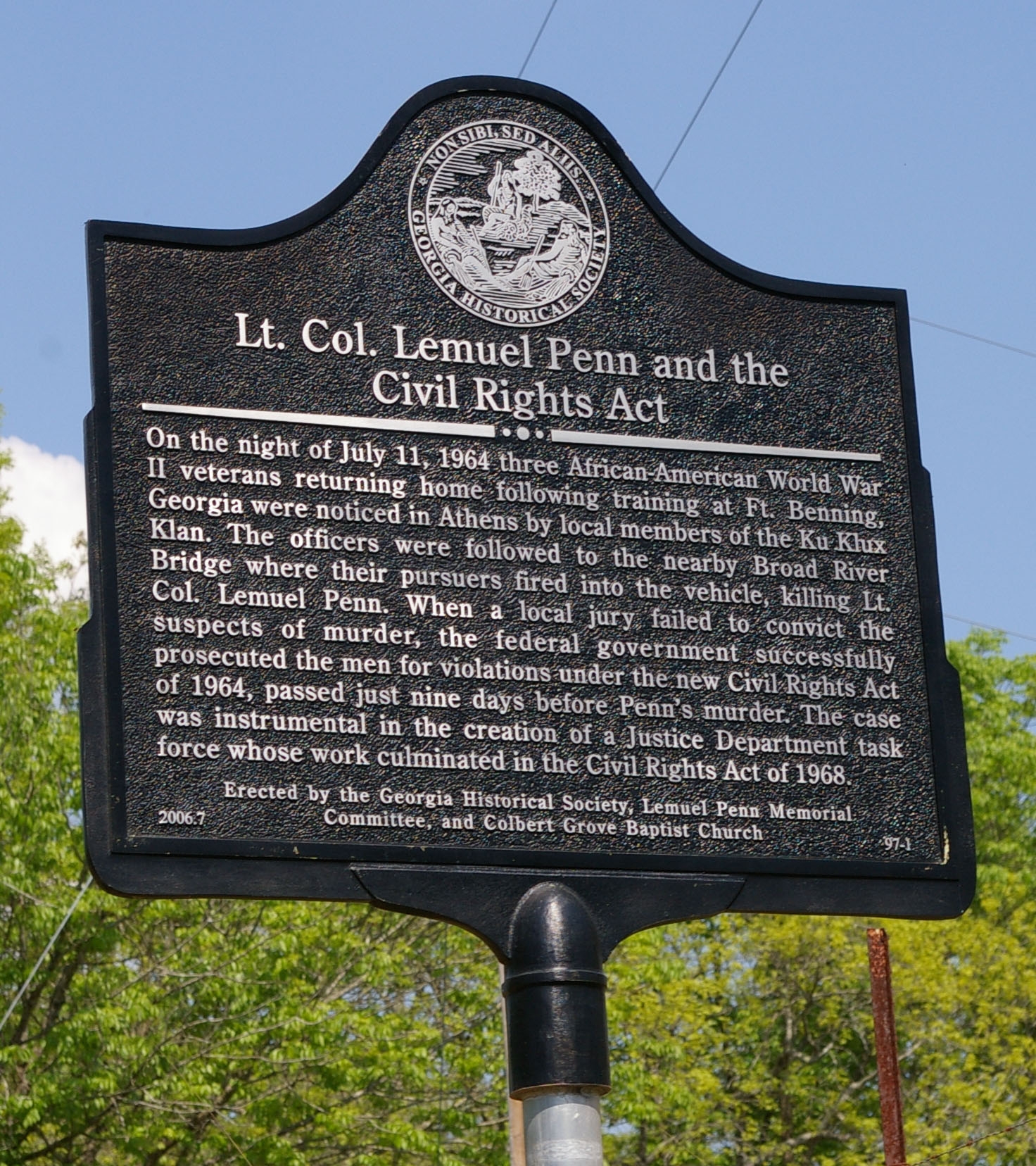
Here's a piece of Georgia history of which I was unaware. (Originally posted at the Southern Graves blog.)

Photo by David Seibert via HMdb.org
"On the night of July 11, 1964 three African-American World War II veterans returning home following training at Ft. Benning, Georgia were noticed in Athens by local members of the Ku Klux Klan. The officers were followed to the nearby Broad River Bridge where their pursuers fired into the vehicle, killing Lt. Col. Lemuel Penn. When a local jury failed to convict the suspects of murder, the federal government successfully prosecuted the men for violations under the new Civil Rights Act of 1964, passed just nine days before Penn’s murder. The case was instrumental in the creation of a Justice Department task force whose work culminated in the Civil Rights Act of 1968."

As you likely (and correctly) surmise, the Klan was unprovoked and the jury that failed to convict was all white.

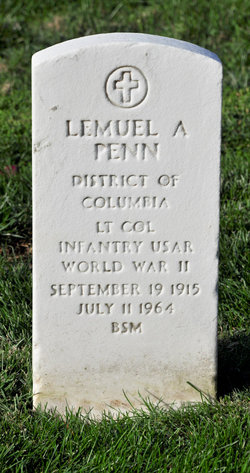
Lemuel Penn rests at Arlington Cemetery.

"NEGRO HERO
Educator Buried in Arlington

WASHINGTON (UPI) -- Lemuel Augustus Penn, Negro educator who was slain by a sniper's shotgun blast as he drove through Georgia, was buried Tuesday with full military honors at Arlington Cemetery, the nation's resting ground for its heroes...

Photo by John Evans via
FindAGrave
Penn, 48, who was in charge of the District of Columbia's five vocational high schools, was shot early Saturday morning near Athens, Ga., while returning to Washington after two weeks of reserve training at Ft. Benning, Ga...

According to the two Reserve officers accompanying Penn, the unexplained and apparently unprovoked shooting was done by a man who drove alongside their car in a rural section of the state, fired twice, then fled. Authorities assume the slaying was racially motivated.

Penn,...is survived by his wife Georgia and three children,...

During the services in the hot, crowded church, the Rev. Stanford J. Harris said Penn was a 'casualty of our battle against bigotry' and his death a reflection of the 'cancerous prejudice eating away at American democracy.'..." [Dallas Morning News (Texas), 15 July 1964, pg. 8 via GenealogyBank.]