Showing posts with label Greene County. Show all posts

31 August 2016

"He was Game to the Core." The Stabbing of Alexander Stephens.

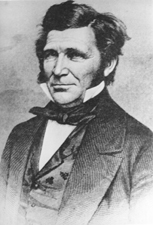
Alexander Stephens (public domain) via Wikimedia Commons.A couple of years ago, I wrote a bit about Judge Francis H. Cone (here and here) and his tombstone at the Southern Graves blog.  The physical attack he made on Alexander H. Stephens (pictured at right) is a well-known incident in Georgia history, yet I did not delve into it there.  While working my way through Lucian Lamar Knight's volumes of Georgia's Landmarks, Memorials, and Legends, I came across a recounting of the fight.  I'll share it here.

Judge Cone's Assault Upon Mr. Stephens.  Alexander H. Stephens was not an athlete.  It is doubtful if the former Confederate Vice-President ever tipped the scales at more than ninety-six pounds, his exact weight in 1843, when he made his maiden speech in the national House of Representatives.  Throughout his long career in public life, he presented the typical look of an invalid, wan and emaciated.  But Mr. Stephens was an utter stranger to the sense of fear, either moral or physical.  He was game to the core; and every ounce of flesh which gripped his spare bones contained as much real pluck as Caesar ever displayed in Gaul.

Let me interject a moment here with some words from a newspaper article titled "Sketches of Georgia Lawyers: Number Five: Francis H. Cone." This article appeared in the 14 June 1867 edition of Georgia's Macon Weekly Telegraph (viewed online at GenealogyBank), and provides a physical description of Cone.  It's interesting to imagine the two combatants side-by-side.

...His person was rather remarkable -- of medium height, full habited and heavy. His face was round and rubicund. No one would mistake him for a starveling -- nor yet for a bon vicant...He relished a glass of wine or other like creature comforts, but was by no means a devotee of Bacchus. His large fleshy face was lit up by eyes black and sparkling, the visible testimonials of geniality and genius. He wore, too, a fine head of hair, which he was accustomed to neglect. He had not the presence of majesty. He did not assume the port of Jove, nor emulate the beauty and grace of Apollo. His gait was shuffling and his manners rough -- something uncouth...

Back to Mr. L. L. Knight:

On the steps of the old Thompson Hotel, in Atlanta, during the fall of 1848, there occurred an incident which well illustrates the courage of Mr. Stephens.  It will also serve to show that he bore a charmed life.  At this time he encountered somewhat unexpectedly Judge Francis H. Cone, of Greensboro, with whom he was then on strained terms.  Judge Cone had severely criticized Mr. Stephens for something which the latter had either said or done in Congress, and among other choice epithets which the Judge is said to have used was the term "traitor".

Difficulties almost immediately ensued…Judge Cone, delving underneath his broadcloth, whipped out a knife with which he made a leap toward Mr. Stephens.  The later was doubly at a disadvantage, not only because in avoirdupois he was a pigmy beside Judge Cone, but also because he was unarmed, except for an umbrella which shot out from his left elbow…Mr. Stephens sought to parry the blow of Judge Cone; but he was soon overpowered by his antagonist and fell bleeding upon the floor.

"Retract!" demanded the irate jurist, who now bent over his prostrate foe.

"Never!" replied Mr. Stephens, the blood gurgling from his wounds, but the proud spirit of the man still unquenched.  Again the knife descended, severing an intercostal artery, but Mr. Stephens still refused to retract.  He continued to grapple with his adversary…until at last rescue came from some hotel guests who, hastening to the scene of the encounter, separated the belligerents.

Mr. Stephens hovered on the brink of death for weeks, but eventually "arose from his sick bed" and returned to politics.  Mr. Knight goes on to say Judge Cone was "a man much beloved in his social and domestic relations, [and] it may be said that he was completely upset by his violent anger." Not sure what good that did for Mr. Stephens, who never fully regained the use of his right hand and bore scars from the battle for life.

Francis H. Cone died 11 years after the brutal encounter.  He was laid to rest in Greensboro City Cemetery at Greene County, Georgia.

honfhcone

To The Memory of the
Hon. Francis H. Cone
1797 - 1859

(As an Amazon Associate I earn from qualifying purchases.)

18 June 2016

More About Distinguished Georgian, William C. Dawson

It's been three years, almost to the day, since I posted "William C. Dawson: Grand Master of Masons in Georgia." The article details a portion of a visit to Greensboro, Greene County, Georgia.  While there, I photographed a historical marker about Senator Dawson, and paid a visit to his grave in the city cemetery.

I've been working my way through Lucian Lamar Knight's Georgia's Landmarks, Memorials, and Legends (1913), and just yesterday come across some information regarding the family of William Crosby Dawson:

In the town cemetery at Greensboro rest two distinguished Georgians, both of whom wore the toga of the United States Senate, besides illustrating Georgia on the Superior Court Bench:  Thomas W. Cobb and William C. Dawson.

The Dawson Family Record

Judge Dawson was twice married, first, in 1820, to Henrietta, daughter of Dr. Thomas Wingfield; and, second, in 1850, to Eliza M. Williams, a widow, of Memphis, Tenn.

His eldest son, William Reid Dawson, died while a student at the University of Georgia, in the junior class.  The second child was Henry M. Dawson, who died at the age of three years.  Next came George Oscar Dawson, who became a lawyer of Greensboro and frequently represented the County of Greene in the State Legislature.  The fourth child was Henrietta Wingfield, who became the wife of Joseph B. Hill, of Columbus.

Edgar Gilmer Dawson, the fifth child, married the only daughter of Dr. William Terrell, of Sparta, an eminent physician and member of Congress.  Soon after being admitted to the bar, Mr. Dawson moved to Columbus.

Emma Caledonia, the sixth child married Edward W. Seabrook of South Carolina, the nephew of Gov. Seabrook.

Lucien Wingfield Dawson, the seventh and last child, became a lawyer of Greensboro and married Eliza, daughter of George Dent, of Athens.

24 March 2016

Sheriff Wyatt's Jail in Greensboro

Almost three years ago, I wrote in this space about Greensboro, Georgia's Spooky Old Gaol.  This structure was used to house (and hang) criminals until about 1895.  At that time, a new jail was established.  After the death of legendary Sheriff L. L. Wyatt, that "new" jail (though more than eighty years old at the time of Wyatt's death) was given his name.

100_3774Outside the jail is a historical marker that tells the tale of the professional life of Sheriff Wyatt:

"SHERIFF L. L. WYATT

This 1895 jail is named for the legendary Sheriff, Loy Lee Wyatt, who enforced the laws in Greene County for fifty-two years until his death in 1977.  Sheriff L. L. Wyatt was born on January 2, 1904, in Paulding County.  He was recruited to serve the citizens of Greene County due to his fast legs and honest reputation.  In 1925, L. L. Wyatt began his law enforcement career as a Greene County policeman who waged a "one-man war" against the making of illegal corn whiskey.  Prior to his arrival, moonshine production was considered the leading industry in Greene County and its product was enjoyed in all of the finest hotels of Atlanta.  After having rid the County of its moonshiners, Wyatt ran for the Office of Sheriff in 1940 defeating the incumbent.  He served as Sheriff until he died in 1977.  At the time of his death he was the longest standing Sheriff in the State, with thirty-seven years of service.

During his 37 years as Sheriff, Wyatt became a legend in his own time.  Few men become legends and even fewer achieve the status of a "living legend" as did Sheriff Wyatt.  He was a religious man who believed that God blessed him with protection during all of his fights, gun battles, and dangerous encounters.  His law enforcement exploits exposed him to at least five gunshot wounds in the line of duty, in part due to the fact that he seldom carried a gun on his person, requiring him to retrieve it from his car at the sight of danger.  In the early days of his career, when

(Continued on other side)

100_3775moonshiners resisted arrest, Wyatt regularly shot it out with them.  He killed over a half dozen men, all of whom shot at him first.

The most famous gunfight of Sheriff Wyatt's career occurred in 1974.  He was 70 years old at the time.  Bank robbers eluded a 100-car police chase that started in Wrens, Georgia, and ended in Greene County.  The bank robbers had killed a teller at the bank in Wrens and had taken two women hostage.  Sheriff Wyatt set up a road block midway between Union Point and Greensboro.  Wyatt stood in the middle of the road as the speeding car approached.  The robbers attempted to shoot him, but the gun misfired.  One bank robber was killed in the ensuing battle, but both women were unharmed.  Sheriff Wyatt subsequently received the award of Peace Officer of the Year for his bravery in this incident.

Sheriff Wyatt was a family man, devoted to his wife, son, and grandchildren.  He was a businessman, lending his experience to the operation and affairs of the Citizens Union Bank as a director.  He was a community leader who had concern for all citizens – rich and poor, black and white.  Out of a concern for these people, legend has it that Sheriff Wyatt confronted a notorious member of the Dixie Maffia and proclaimed, "These are my people and I want you to leave them alone!"

Sheriff Wyatt, also known as Mr. Sheriff, was the epitome of a community oriented police officer long before such an idea was born and served as an example for every officer to follow."

According to his burial notice in the Augusta Chronicle (Georgia, 11 April 1977, sec. A, pg. 11, as viewed online at GenealogyBank), Loy Lee Wyatt died 8 April 1977 "after he was stricken with an apparent heart attack." The notice goes on to say, "During his tenure [as Sheriff], Wyatt gave Greene county a reputation as one [of] Georgia's most crime-free areas.  Along the way, he was shot five times and narrowly escaped death twice in car crashes during chases."

Sheriff Wyatt was laid to rest at Greensboro Cemetery.

100_3776


22 June 2013

William C. Dawson: Grand Master of Masons in Georgia

[Originally posted at the Southern Graves blog.]

William Crosby Dawson
via Wikipedia
I headed out before the sun came up one morning several days ago to visit a few cities with roots in early Georgia history. My first stop was Greensboro, the seat of Greene County. It was first chartered in 1786, and later incorporated in 1803. I parked in front of the courthouse with every intention of walking around the back to take a peek at the old jail. Even though it was raining, I was sidetracked by a marker in front of the courthouse detailing the life of William C. Dawson. After reading it, I snapped a picture and moved on. Little did I know, I would visit Mr. Dawson again a bit later...in the cemetery, of course!

William C. Dawson marker in front of
Greene County's 1849 courthouse.
Marker reads: William C. Dawson (1798-1856), Statesman -- Soldier -- Jurist -- Freemason: "A native of Greene County, then on Georgia's Indian frontier, he was educated in the law and admitted to the bar in 1818. The remainder of his exemplary life was spent in the public service as Legislator, Captain of Volunteers in the Indian War of 1836 in Florida, Judge of the Ocmulgee Judicial Circuit, Congressman, and U.S. Senator from Georgia from 1849 to 1855.

A member and officer of historic San Marino Lodge No. 34, F & A. M. Greensboro, GA, first chartered in 1821 and which lodge has had its quarters atop the Greene County courthouse here since 1849, Brother Dawson served as Grand Master of Masons in Georgia from 1843 until his death in Greensboro on 6 May 1856. Two cities and one county in Georgia are named for him. Also named in his honor are two Masonic lodges: Dawson No. 68, F & A. M. Social Circle, GA, and Dawson No. 16, F. A. A. M. at Washington, D.C.

One of the most beloved, respected and distinguished grand masters in Georgia's long Masonic history his honored remains lie in the city cemetery near this spot. His entire life was a testimonial to his devotion to his fellowman, his country and to the sublime precepts of Freemasonry. His name will always be revered by the Freemasons of Georgia."

A short time later I was in Greensboro City cemetery, and even though I wasn't purposefully looking for it, visiting the grave of William Crosby Dawson.

WILLIAM C. DAWSON
was born on the 4th day of January, 1798,
and died on the 6th day of May, 1856.
Bred to the Bar, he entered upon his profession in
1818, and prosecuted it successfully until his death.

HE WAS AN ABLE JURIST,
an eloquent Advocate, and an upright Judge.  Cautious, practical
and independent, as a Statesman; he commanded confidence by the
frankness of his manners, the purity of his motives, and the wisdom
of his counsels.

THE STATE OF GEORGIA HONORS HIS MEMORY,
for his fidelity to her numerous trusts.
HIS NEIGHBORS CHERISH
it because he was kind and liberal to them,
AND HIS FAMILY REVERE
it because as Husband, Parent and Master, he was
affectionate, considerate, gentle and true.

Upon his death, obituaries appeared in newspapers all over the country. I read several from up and down the east coast, including Maryland and New York. The following is an example of the opening paragraph found in many. This one from South Carolina's Charleston Courier (8 May 1856, pg. 2):

"We are called on to announce the decease of one of Georgia's most honored citizens of public station and renown, and one who had worn fitly and faithfully the highest honors of the State. The Hon. William Crosby Dawson expired at an early hour on Tuesday, the 6th inst., at his residence in Greensboro, Ga., of an attack of bilious cholic."

All photos, sans the one credited to Wikipedia, are © 2013 S. Lincecum.