Showing posts with label Politics. Show all posts

02 January 2018

Only Negro Voter Killed: a Georgia Civil Rights Cold Case Project

MariettaJournal1946-07-28Maceo Snipes was an honorably discharged World War II veteran when he went to cast his vote in the 1946 Georgia Democratic primary for governor.  He was also a black man.

Earlier that year, federal courts struck down the usual "whites only" voting rule for primaries in Georgia.  Eugene Talmadge, one of the candidates for governor, denounced the decision "as a threat to segregation, [and] promised to restore the white primary and to keep blacks in their place in Jim Crow Georgia." [Source]

In spite of threats from the Ku Klux Klan, Maceo Snipes bravely became the first African American to cast a ballot in Taylor County, Georgia.  Days later, he was dead.  Erica Sterling wrote for The Georgia Civil Rights Cold Cases Project at Emory University in August 2014:

The day after Snipes voted, four white men arrived in a pick-up truck outside of his grandfather’s farmhouse, where Snipes and his mother Lula were having dinner. The men, rumored to be members of the local Klan chapter, called for Snipes, who came outside to meet them. During their encounter outside the house, Edward Williamson, who sometimes went by the name of Edward Cooper, shot Snipes in the back.

There are varying stories as to how Mr. Snipes got to the hospital, but he got there.  Then he waited while the doctor worked on other patients.  (I wonder how many of them had gun-shot wounds.)

Approximately six hours lapsed from the time Williamson shot Snipes until the doctor performed surgery to remove the bullets, the family would later say. The story that still resonates from that day in the Snipes family carries the same theme of medical neglect found in other Georgia civil rights cold cases: Not long before he died, Snipes was talking actively with his family. The white doctor at one point said Snipes would need a transfusion, then said it would be impossible because there was no “black blood” available at the hospital…Without a transfusion, Snipes died from his injuries two days later, on July 20.

Because of the rumored threat to the lives of anyone daring to attend the funeral for Maceo Snipes, he was reportedly buried in the middle of the night in an unmarked grave in Butler, Taylor County.

NAACP Headquarters, New York City. Via Library of Congress (loc.gov).News Article from the Time

Marietta Daily Journal (Georgia)
Sunday, 28 July 1946 – pg. 5 [via GenealogyBank]

Only Negro Voter In Rupert Killed
ATLANTA, July 27. – (UP) – The Walton county lynching of four Negroes follows by one week the death of Macio Snipes, a Negro war veteran at Rupert, Ga.

Snipes was the only Negro to vote at Rupert in the Georgia primary that returned white supremacy candidate Eugene Talmadge to the Governor's chair.

A coroner's jury ruled that he was killed by one of four white men who called at his home.

The fact that he was the only Negro voter in the precinct, said the jury, was only a coincidence.  The jury said the men went to his house to collect a debt.

The killer/s also claimed self-defense; the coroner's jury called the shooting justified.

[Note: the "Walton county lynching" mentioned in the above article refers to the Moore's Ford lynching of George Dorsey, Mae Murray Dorsey, Roger Malcolm, and Dorothy Malcolm – the "last mass lynching in America."]


Links to more about the killing of Maceo Snipes:
· Answers Sought in 1946 Ga. Killing (Washington Post article dated 13 February 2007)
· Killing and Segregated Plaque Divide Town (New York Times article dated 18 March 2007)
· U.S. Department of Justice Notice to Close File (updated 29 September 2016)

The Tuskegee Institute, under its founder Booker T. Washington, recorded data on lynchings.  The guidelines used to decide if a killing was to be deemed a lynching were the following:  “There must be legal evidence that a person was killed. That person must have met death illegally. A group of three or more persons must have participated in the killing. The group must have acted under the pretext of service to justice, race or tradition.” [Source: 100 Years of Lynchings]

Some might not consider the murder of Maceo Snipes to be a lynching.  I do.

17 December 2017

NAACP Gets Charges Brought, but Still No Justice for Joe Jordan & James Harvey

The story of the lynchings of Joe Jordan and James Harvey begins in the following manner, as told by Fitzhugh Brundage in Lynching in the New South:

During the summer of 1921, Harvey and Jordan had hiked throughout the Deep South before stopping to work for a few months in Wayne County in south Georgia.  The young men, one of whom was a war veteran, quickly became ensnared by the worst forms of coercive practices of southern agriculture and were unable to compel their white employer to pay them…[A]fter the men had demanded their wages, their employer's wife brought charges against them for attacking and raping her.

Three days later, while Jordan and Harvey sat in a Savannah jail – without defense counsel who cared one way or the other – the two were found guilty and sentenced to death.

NAACP Headquarters, New York City. Via Library of Congress (loc.gov).An uncle of James Harvey then contacted the NAACP for help.  The organization hired a white lawyer, James A. Harolds of Jesup, GA,  to represent Jordan and Harvey.  The lawyer succeeded in getting the case to the state supreme court, but the higher institution upheld the lower court's verdict.

The publicity of the case even prompted some prominent white women of Wayne County to get involved.  In May of 1922, about eight months after the original conviction, a local judge was petitioned to grant Jordan and Harvey a new trial based on newly discovered evidence.  The petition was denied, so the NAACP played the last card they had by petitioning the governor of Georgia, Thomas W. Hardwick, for executive clemency.  On the very date of their scheduled execution, Jordan and Harvey were granted a reprieve.

Savannah Tribune (Georgia)
Thursday, 13 July 1922 -- pg. 1 [via GenealogyBank]

N.A.A.C.P. PROTESTS LYNCHINGS

Governor Called Upon To Institute Action Against Sheriff

New York, July 7, – How two young colored boys, James Harvey and Joe Jordan, who were accused of attempted criminal assault while on a hiking tour through Georgia, were tried, convicted, and sentenced to death, and then lynched after Governor Thomas W. Hardwick had granted a respite of thirty days, was revealed here today when the National Association for the Advancement of Colored People made a public letter to Governor Hardwick.  The letter, signed by James Weldon Johnson, secretary, recites the facts given above, pointing that both of the youths came from respectable families, and that the Association had investigated their case, secured convincing proof of their innocence, employed counsel, which counsel had presented the facts to the governor which gave him sufficient ground to delay their execution set for June 30.  A mob, determined not to be cheated of their prey, had seized the boys and lynched them north of Lane's Bridge, Georgia, on July 1.

The association's letter calls upon the governor to institute action against Deputy Sheriff J. R. Tyre who allowed the prisoners to be taken from him as he was carrying them from Jesup to Savannah for safe-keeping, and against Tyre and his immediate superiors for furnishing so inadequate protection to the men in view of the feeling against them.  It also emphasizes the fact that evidences against the men must have been indeed slight if he as governor had seen fit to grant the requested respite.  This action was particularly urged in view of Governor Hardwick's recent public declaration that there would be no mob rule in Georgia while he was governor.

Governor Hardwick bowed to pressure, and charges of murder were brought against five individuals after a probe which lasted more than two months:  L. W. Rhoden, chief of police of Jesup; J. R. Tyre, deputy sheriff of Jesup and Brunswick; Bob L. Price, Wayne County; Dock Rhoden, Wayne County; and Carl Stuart, Telfair County.

MaconTelegraph1923-02-24

Five months later, all were acquitted – in spite of some pretty damning evidence.  But it was obvious no juror ever intended to truly weigh the facts and come to a thoughtful verdict.

Macon Telegraph (Georgia)
Saturday, 24 February 1923 -- pg. 1 [via GenealogyBank]

FIVE ARE ACQUITTED IN HINESVILLE LYNCHING CASE

JURORS ARE OUT FOR 10 MINUTES BEFORE VERDICT

…WOMAN FEATURE WITNESS

Negroes' Death Favored By Sheriff, Mrs. Magett Says

HINESVILLE, Ga., Feb. 22. – A verdict of not guilty was returned by a jury here late this afternoon in the cases of James R. Tyre, Carl Stewart, Bob Price, Dock Rhoden and Chief of Police L. W. Rhoden, of Jesup, charged with murder in connection with the lynching of two negroes, Joe Jordan and James Harvey, on June 30, of last year.

…[F]our defendants took the witness stand in their own defense, that being the only testimony offered by the defense.

The verdict was reached ten minutes after the jury retired, apparently being decided on the first ballot…

Four defendants made practically the same statement.  Deputy Sheriff Tyre, the first to testify, told of leaving Jesup with the two negroes, and starting on his trip to Savannah, via automobile.  At the fork of "some road," he said, they were stopped by an automobile, parked across the road, with the lights burning.

One Acts as Spokesman
"One made did all the talking," Sheriff Tyre said.  "We were told to hand over the two negroes, go on back to Jesup, and keep our mouths shut.

"We started back to Jesup after they took the negroes, and lost our way.  Then we ran out of gasoline.  I paid a negro to get us some gas and finally, we reached Hinesville.  I then called up Jesup and reported the affair."

…Sensational testimony by Mrs. Vera Magett, juvenile probation officer of Jesup, and Morrison Thomas, also of Jesup, in which Sheriff Tyre was directly involved, featured the hearing of state witnesses.

Claims Lynching Favored
"I have been a target for those two negroes long enough," Sheriff Tyre was quoted as saying, by Mrs. Magett.  "If the people want to lynch them," she continued, "let them come to the jail and get 'em."

Mrs. Magett further quoted the sheriff as praising the lynching if another respite was granted the two negroes by Governor Hardwick.

Morris Thomas told of his interview with Carl Stewart on the night of the lynching.  He said he met Stewart and Price at the railroad station and that he jokingly asked them where they were going.  They replied seriously, he said, that "We are going to a lynching," he quoted Stewart.  The witness stated that there were numerous rumors heard about Jesup that night predicting a lynching and fixing the time at 10 o'clock.

The witness was later recalled to tell of his interview with Sheriff Tyre at the postoffice [sic] on the day following the lynching.  Thomas said Tyre received a package, postmarked from Savannah, which he asked him (Thomas) to open.  This, the witness said, he did, and discovered that the package contained a revolver.  Sheriff Tyre then explained to him that the revolver was taken from him by the men which met them between Hinesville and Savannah, and lynched the two negroes…

The research of Mr. Brundage adds the following regarding the NAACP's involvement after the lynchings:

Unwilling to let the case drop, members of the Savannah branch of the NAACP traveled to the site of the lynching, saw to it that Jordan and Harvey were properly buried, and began gathering evidence against the lynchers.  The investigations left little doubt that the deputy sheriff and policemen who had been transporting the prisoners were complicitous in the event.  Numerous local witnesses claimed that the two officers had waited for hours at the site of the lynching until the mob arrived and "seized" Harvey and Jordan.

According to MonroeWorkToday, the lynchings of Joe Jordan and James Harvey are also referenced in A Festival of Violence: An Analysis of Southern Lynchings, 1882-1930.

From NY Public LibraryA simple search on Google will give you the statistics. The Tuskegee Institute kept track of lynchings in America from 1882 - 1968. There were 581 in Mississippi, 531 in Georgia, 493 in Texas, 391 in Louisiana, 347 in Alabama, and so on. Total from all states: 4,743. That's more than one lynching and victim a week.

I feel a little like I should try to explain why I would give the horrible acts – those committed by the criminal, as well as those committed on the criminal – voice on this blog. There are no (at least to my knowledge) statistics showing the accuracy of the lynchers. How many times was an innocent person hung, riddled with bullets, and mutilated in the name of "justice?" I mean, we probably agree there are innocent people sitting in jail right now – with supposed checks and balances in place. Imagine when there were none. Shouldn't those innocent people be remembered?

Now, make no mistake, sometimes the lynching party "punished" the right person. As in, sometimes the true perpetrator was indeed apprehended – and then disposed of, often in a barbaric fashion. Even if you take the literal "eye for an eye" death penalty approach, I would not be surprised if that would have been an applicable punishment in only an infinitesimal number of cases. People were lynched for stealing, people were lynched for "insubordination," people were lynched for literally being in the wrong place at the wrong time. And let us not be cowards and leave out the racism debacle that lingers to this day. So another reason for giving voice to these past atrocities is in the same vein of "Those who cannot remember the past are condemned to repeat it."

As a family historian, I am saddened to think (1) these revolting deeds took place, and (2) while statistics are easy to find, the names and stories of the individual victims are much harder to locate. A list of lynching victims will unfortunately never be complete. I hope that in a small way, posts such as these will serve as a memorial to those who were victims of Judge Lynch and his frightful law.

31 August 2016

"He was Game to the Core." The Stabbing of Alexander Stephens.

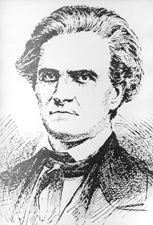
Alexander Stephens (public domain) via Wikimedia Commons.A couple of years ago, I wrote a bit about Judge Francis H. Cone (here and here) and his tombstone at the Southern Graves blog.  The physical attack he made on Alexander H. Stephens (pictured at right) is a well-known incident in Georgia history, yet I did not delve into it there.  While working my way through Lucian Lamar Knight's volumes of Georgia's Landmarks, Memorials, and Legends, I came across a recounting of the fight.  I'll share it here.

Judge Cone's Assault Upon Mr. Stephens.  Alexander H. Stephens was not an athlete.  It is doubtful if the former Confederate Vice-President ever tipped the scales at more than ninety-six pounds, his exact weight in 1843, when he made his maiden speech in the national House of Representatives.  Throughout his long career in public life, he presented the typical look of an invalid, wan and emaciated.  But Mr. Stephens was an utter stranger to the sense of fear, either moral or physical.  He was game to the core; and every ounce of flesh which gripped his spare bones contained as much real pluck as Caesar ever displayed in Gaul.

Let me interject a moment here with some words from a newspaper article titled "Sketches of Georgia Lawyers: Number Five: Francis H. Cone." This article appeared in the 14 June 1867 edition of Georgia's Macon Weekly Telegraph (viewed online at GenealogyBank), and provides a physical description of Cone.  It's interesting to imagine the two combatants side-by-side.

...His person was rather remarkable -- of medium height, full habited and heavy. His face was round and rubicund. No one would mistake him for a starveling -- nor yet for a bon vicant...He relished a glass of wine or other like creature comforts, but was by no means a devotee of Bacchus. His large fleshy face was lit up by eyes black and sparkling, the visible testimonials of geniality and genius. He wore, too, a fine head of hair, which he was accustomed to neglect. He had not the presence of majesty. He did not assume the port of Jove, nor emulate the beauty and grace of Apollo. His gait was shuffling and his manners rough -- something uncouth...

Back to Mr. L. L. Knight:

On the steps of the old Thompson Hotel, in Atlanta, during the fall of 1848, there occurred an incident which well illustrates the courage of Mr. Stephens.  It will also serve to show that he bore a charmed life.  At this time he encountered somewhat unexpectedly Judge Francis H. Cone, of Greensboro, with whom he was then on strained terms.  Judge Cone had severely criticized Mr. Stephens for something which the latter had either said or done in Congress, and among other choice epithets which the Judge is said to have used was the term "traitor".

Difficulties almost immediately ensued…Judge Cone, delving underneath his broadcloth, whipped out a knife with which he made a leap toward Mr. Stephens.  The later was doubly at a disadvantage, not only because in avoirdupois he was a pigmy beside Judge Cone, but also because he was unarmed, except for an umbrella which shot out from his left elbow…Mr. Stephens sought to parry the blow of Judge Cone; but he was soon overpowered by his antagonist and fell bleeding upon the floor.

"Retract!" demanded the irate jurist, who now bent over his prostrate foe.

"Never!" replied Mr. Stephens, the blood gurgling from his wounds, but the proud spirit of the man still unquenched.  Again the knife descended, severing an intercostal artery, but Mr. Stephens still refused to retract.  He continued to grapple with his adversary…until at last rescue came from some hotel guests who, hastening to the scene of the encounter, separated the belligerents.

Mr. Stephens hovered on the brink of death for weeks, but eventually "arose from his sick bed" and returned to politics.  Mr. Knight goes on to say Judge Cone was "a man much beloved in his social and domestic relations, [and] it may be said that he was completely upset by his violent anger." Not sure what good that did for Mr. Stephens, who never fully regained the use of his right hand and bore scars from the battle for life.

Francis H. Cone died 11 years after the brutal encounter.  He was laid to rest in Greensboro City Cemetery at Greene County, Georgia.

honfhcone

To The Memory of the
Hon. Francis H. Cone
1797 - 1859

(As an Amazon Associate I earn from qualifying purchases.)

12 August 2016

Ambrose Baber had the Misfortune to Kill Thomas Mitchell in a Duel

Grave of Dr. Ambrose Baber"It is hardly an exaggeration to say that not less than a thousand duels were fought in Georgia in consequence of this feudal enmity between Clark and Crawford; and there were few households in the State which were not bereaved, either directly or indirectly, by the countless sacrifices which were made during this period to appease the demands of this bloody Moloch." [Lucian Lamar Knight, Georgia's Landmarks, Memorials, and Legends, Vol. II]

Ambrose Baber was a medical doctor who could not resist the political life.  He represented the United States as Minister to Sardinia, and he sat repeatedly in the Georgia State Senate.  "He was a power in politics," wrote L. L. Knight, "but among the other distinguishing marks of this accomplished gentleman was his deadly aim with a pistol and his expert use of the sword." In short, Dr. Baber was many things – including a duelist.

Dr. Baber was the attending surgeon for Major Robert A. Beall for his 1825 duel with the honorable Thomas D. Mitchell.  Two shots were exchanged without consequence, and Beall and Mitchell shook hands before leaving the field of honor.

Dr. Baber apparently couldn't leave things well enough alone and had a snide comment for Mitchell.  Mitchell retaliated by publishing a "card which gave offence to Dr. Baber, who, after a brief controversy on the subject, demanded of Col. Mitchell the satisfaction due a gentleman under the Code." The challenge was accepted, and the weapon of rifles was chosen.  The particulars follow:

baber-mitchellduelConnecticut Herald (New Haven, Conn.)
28 March 1826, via GenealogyBank

Another Fatal Duel. — We have a letter from a friend at Hamburg, S.C. dated the 9th inst. detailing the particulars and fatal result of an honorable meeting which took place early that morning at Campbell Town, S.C. three miles above Hamburg.  The parties were Doctor Baber and Thomas Mitchell, Esq. of Milledgeville, Geo.  The misunderstanding had its origins in a difference in political opinion, (the former being for "Troup and the treaty," and the latter a Crawfordite and Clarke man,) which proceeded to such lengths that Mitchell posted the Doctor, and made use of the epithets of coward, villain, &c.  The Doctor accordingly challenged him, which Mr. M. accepted, and being, by the rules of duelling [sic], entitled to the choice of weapons, &c. selected short rifles, and to fight at fifteen paces.  The first fire was without effect, when the seconds endeavoured [sic] to comprise the matter, to which the Doctor agreed, provided that Mr. M. would retract the aspersions cast on his character, but the latter refused, at the same time stating that what he had asserted he conscientiously believed, and therefore neither could or would retract.

The rifles were again loaded, and on their both firing at the word, Mr. M. fell mortally wounded, the ball of his antagonist having entered the left breast near the shoulder, and passed out at the right side near the shoulder blade.  He expired in fifteen minutes.

Mr. Mitchell was a native of South Carolina, but had resided for the last few years in Georgia, of which state he was Attorney General. – N.Y. Gaz.


Thomas Mitchell was in his early thirties and unmarried.  His brother, Dr. Isaac Mitchell, was at the duel as the attending surgeon for Thomas.  Dr. Baber lived another twenty years.  He died 8 March 1846 in his home town of Macon, Bibb County, Georgia, and was laid to rest at Rose Hill Cemetery.

04 August 2016

Crawford and Van Allen Exchange Two Fires

But the Golden Age of the Code Duello in Georgia was the period extending from 1800 to 1830, when the public life of this State was dominated by two powerful personalities:  Gen. John Clark and Hon. William H. Crawford. – Lucian Lamar Knight in volume two of Georgia's Landmarks, Memorials and Legends (pub. 1914).

The duel between William H. Crawford and Peter L. Van Allen requires a bit of backstory regarding politics in Georgia. (Go here for a short overview of dueling, with specifics to Georgia.)

John Clark, son of famed Revolutionary soldier Elijah Clark/e, was all about the common man.  He was born in North Carolina, but was settled early on with his family in northeast Georgia.  John Clark's rise in politics stemmed from his early and consistent rise in the military.  By the age of sixteen, he was a captain in the Georgia militia and fought in many engagements alongside his father on the Georgia frontier.

Trained in the exercise of arms, it is not strange that he should have carried his characteristics as a fighter into the arena of politics; nor is it strange that the veterans who followed his distinguished father and who knew John Clark himself in the perilous days of battle should have remained his loyal supporters to the very last.

Though not an educated man, at least in the academic sense, he was a man of strong intellect, rugged in character, somewhat blunt of expression, full of bold initiative, and with a rare capacity for leadership.

Most of John Clark's followers were immigrants from North Carolina and settlers of frontier Georgia.

William H. Crawford, via Wikimedia CommonsWilliam Harris Crawford, on the other hand, led the more "aristocratic" faction.  He was born 1772 in Virginia, was settled at Richmond (later Columbia) County, Georgia by age eleven, and was practicing law by age twenty-seven.  David Tucker, in his article for the New Georgia Encyclopedia, says the following:

William Crawford aspired to live the life of a country gentleman, but he would not get the chance to do so until the end of his career. In the meantime he gradually added to his landholdings at Woodlawn [his estate] and became the overseer of a good-sized plantation. By 1834 he owned 1,300 acres and forty-five slaves.

Leading the plantation owners and residents of the more affluent, established Georgia, Crawford was against "gross land speculation" and the Yazoo Land Act.  This was in direct opposition of John Clark.

The elimination of Crawford became naturally the first strategic move of the Clark faction; and to accomplish this end a duel offered the most convenient instrument and promised the most effective results.

Mr. Crawford, unlike Gen. Clark, possessed little knowledge of the use of arms…For this reason, his opponents argued that he would, in all likelihood, decline a challenge to the field of combat.  In fact, such a refusal to fight was exactly what his enemies wanted, since they could then post him as a coward and easily accomplish his political undoing. [L. L. Knight]

Enter Peter Van Allen.  Though a New Yorker by birth, Van Allen came to Georgia to practice law.  He was a staunch "Clarkite" and supporter of the Yazoo Act.  In the very early 1800s, Van Allen began "hostile tactics" to discredit Crawford.  He did this by going after a long-time friend, law partner, and ally of Crawford, Judge Charles Tait.  The short of the story is Van Allen baited Tait hard with criticism and "merciless satire" – needling him to the point to which Tait challenged Van Allen to a fight.  Van Allen then attempted a shot in the dark to get to Crawford.  He claimed Tait was not a gentleman, nor worthy of the Code of Honor by which all duels are "ruled," and refused to meet him.  With this, Van Allen expected Crawford (who would surely have been Tait's "second" for the duel) to "carry on hostilities." Crawford did not take the bait, though he did receive some jeers from members of his own faction.

Some time later, Crawford and Van Allen happened upon each other "at the Willis Hotel, in Washington, Ga." Van Allen took the direct approach and publicly berated Crawford in the lobby and challenged him to a fight.

According to the imperious standard of the times, there was no alternative for Mr. Crawford; and, rather than jeopardize his political fortunes by exposing himself to the charge of cowardice, he agreed to meet his antagonist. [L. L. Knight]

Sunset Clarks Hill Lake - License CC BY-SA 3.0 via Wikimedia CommonsCrawford and Van Allen were to meet at "Fort Charlotte, the famous old duelling [sic] ground, twelve miles below Petersburg, on the Carolina side." (Now under the waters of Clarks Hill Lake.) It has been said that Crawford was ill prepared, and had to borrow an old set of pistols for the fight.  The rest is told in a Spooner's Vermont Journal article dated 5 October 1802 (viewed online at GenealogyBank):

ANOTHER DUEL
On Saturday the 31ft July, about 11-o'clock, a duel was fought on the eaft bank of Savannah river, between Peter L. Van Allen, Efq. Solicitor general, and W. H. Crawford, Attorney at law. – They exchanged two fires; the firft was without effect, but the fecond was fatal to the Solicitor.  He received a ball about two inches above his right hip, it paffed thro' the Abdomen and lodged againft his left hip bone, from whence it was extracted on the ground.  He lived about 38 hours.

Crawford was thrust into the limelight and rose even higher in the political ranks, probably much to the disappointment of John Clark.  The two were to be bitter rivals for more than two decades.

18 April 2015

Walter T. Colquitt, by Lucian Lamar Knight

Walter T. Colquitt
[Wikimedia Commons]
The following is a sketch of Walter T. Colquitt, namesake of Colquitt County, as penned by Lucian Lamar Knight for his 1914 publication, Georgia's Landmarks, Memorials and Legends:
Judge Walter T. Colquitt was one of the most brilliantly gifted of Georgia's ante-bellum statesman. As an orator his achievements on the hustings have rarely been excelled; he was also a minister of the gospel and a jurist of high rank; and by reason of his prestige as a popular leader he was elected to a seat in the Senate of the United States. Judge Colquitt came of English stock and was born in Halifax County, Va., on December 27, 1799. His boyhood days were spent in Hancock County, Ga., whither his parent removed and he received his education in the famous academy at Mt. Zion. Later he located in Columbus, where he continued to reside until his death. He was twice elected to Congress as a Whig; but, on the nomination of William Henry Harrison, he gave his support to Van Buren, the nominee of the Democrats. Notwithstanding this change of fronts -- the result of deliberate conviction -- he was soon thereafter elected to the United States Senate, where his power as an advocate was most distinctly felt; but he resigned his seat in 1848, taking no further part in politics. Judge Colquitt died at his home in Columbus, while in the meridian of life, at the age of fifty-six. He is buried in Linnwood [sic] Cemetery, on the Jeter lot, where his grave is unmarked. Judge Colquitt was three times married. Of his children -- Alfred H. Colquitt, "the hero of Olustee," became a Major-General in the Confederate Army, Governor of Georgia, and United States Senator; while Peyton H. Colquitt was killed at the head of his regiment while leading a gallant charge, in the Battle of Chickamauga, in 1863.
Judge Colquitt's son Peyton was also interred at Linwood Cemetery. I have posted about him at the Southern Graves blog.

Photo © 2006 S. Lincecum

28 March 2013

William R. Cox, a Biographical Sketch

From Memoirs of Georgia, Volume II by The Southern Historical Association, 1895.
Transcribed by S. Lincecum about 2006.

William R. Cox, senior member of the large wholesale grocery firm of Cox & Chappell, Macon, Ga, is a native of the county in which he now resides. He is a son of D. M. Cox, who soon after his birth, April 4, 1843, removed to Houston county. Here William R. came to years of maturity, receiving such education as could be had in the ordinary schools of that period. The war between the states was the first great event of his life, and though but a youth, he did battle bravely for the undying principles of the Confederacy. Mr. Cox enlisted in the First Georgia, in April of 1861, and passed the twelve months of that enlistment in Pensacola, Fla., and in Virginia. Returning to Macon when his enlistment had expired, the company of which he was a member a month later was mustered into the artillery service and joined Ge. Bragg, who was operating in the department of Tennessee. As a corporal of this company Mr. Cox followed it with varying fortune through a large number of important campaigns and it is but just to add that they were looked upon as one of the most efficient and skilled batteries in the western army. Mr. Cox received a slight wound at Perryville, Ky, but otherwise returned from the war unharmed. Perry, Houston Co., was the point at which Mr. Cox made his first business venture, but disposing of his interests there in 1868 he came to Macon, where he began at the bottom round, clerking for several years. He afterward became junior member of the firm of Jacques, Johnson & Cox, wholesale dealers in liquors and cigars. He subsequently established in company with Mr. Corbin the firm of Cox & Corbin, and now handles groceries and provisions exclusively. The domestic life of Mr. Cox has been most felicitous, his home having been presided over since November of 1873 by Lizzie, the accomplished daughter of Col. J. E. Jones, a former president of the Central Georgia bank, and for long years a leading spirit in the business circles of Macon. After his death Mr. Cox purchased the old Jones homestead, one of the mose beautiful residence properties in the city, where he now resides. William R. Cox is a wide-awake business man, and is interested in various business enterprises. He is vice-president of the Central Georgia bank, and a director of the Southwestern railroad. In politics he votes the democratic ticket, is a Methodist in religion, and is an ex-alderman of the city of Macon, and president of the Alexander free school board of that city.

27 March 2013

William A. Davis, a Biographical Sketch

From Memoirs of Georgia, Volume II by The Southern Historical Association, 1895.
Transcribed by S. Lincecum about 2006.

William A. Davis, one of the most prominent business men in Bibb county, was born on a farm eight miles east of Macon, Ga, April 4, 1847, living there until he was thirty years of age. He studied at Jeffersonville, Twiggs Co., Ga, in the years 1861-2-3. In 1863, though but sixteen years old, he entered the Confederate service, enlisting in Company B, Second Georgia battalion of cavalry, as a private, and later was made orderly sergeant, serving as such until the surrender. He fought in the battles of Chickamauga and Griswoldville, participated in many skirmishes, and left the service with an enviable record. After the cessation of hostilities he resumed his studies at the academy of Allentown, Twiggs Co., of which James E. Croslin, an educator of reputation, was principal, and then returned to his home in Bibb county, being called there by the death of his father. He managed the homestead from 1866 to 1877, during which period he was elected to represent Twiggs county on the general assembly, and during the session served with distinction on the committees on agriculture, public institutions and other matters before the legislature. A majority of his fellow-members not favoring the permanent institution of the college at Dahlonega, a bill to that end was defeated, but Mr. Davis secured a reconsideration and succeeded to having the bill passed, to which fact the agricultural college at that point now owes its existence, and for which service he received unstinted praise. Entering municipal as well as state politics Mr. Davis has been elected alderman from three different wards of the city of Macon -- serving six years in all in the city council -- and for four years of that time he acted as mayor pro tem. He has also been road commissioner from his district for several years. In 1880 he came to Macon and five years later, in company with M. C. Balcomb, engaged in the business of handling cotton, the style of the firm being Davis & Balcomb. The firm existed until 1890, when it was re-arranged under the title of W. A. Davis & Co., and now continues as such. For years Mr. Davis was a director of the Merchants' National bank of Macon, which went into voluntary liquidation in 1893. He is now vice-president and director of the Guarantee company of Macon, and has interests in various other business enterprises. He is a thirty-second degree Mason and a Mystic Shriner. He has held all the principal offices in the subordinate lodges, to-wit, past master of Macon lodge, No. 5, F. & A. M.; past high priest of Constantine chapter, Royal Arch Masons; past eminent commander of the St. Omar commandery, Knights Templars, and he is at this time grand senior warden of the grand lodge of the state. He is also a member of the I. O. O. F. and the Encampment, having held all the chairs and being at present district deputy grand master. He is past noble grand of the United Brother's lodge, I. O. O. F., and past chief patriarch of the Encampment. He is, as well, a Knight of Pythias. He affiliates with Baptist church, and, while living on his farm, was for many years a deacon of the local church. In 1868 Mr. Davis married Mary R., daughter of J. W. and Susan (Barlow) Summers; they have four children, Hattie B., Edwin, Mabel C. and Gussie M. Edwin is a graduate of Mercer university, Macon. Mr. Davis' father was Elisha Davis, a native of Burke county, Ga, who was several times elected to the general assembly. He was a jurist and served on the bench of the inferior court of Bibb county for many years. He died in 1866 at the age of sixty-one. Two of his sons, in addition to William A., served in the late war. John N. was in the Bibb county cavalry and with the western army almost all the time that army was in the field. Gilbert M. enlisted in Hampton's brigade as a private, saw service during the entire war period, and was mustered out when in command of his company. Elisha Davis' father was John Davis, a Virginian by birth and the son of John Davis, a Welshman, who emigrated from Wales to Virginia and was killed in the revolution at the battle of Brandywine. William A. Davis has won his way in life by force of individuality and honest determination to succeed, using his great natural abilities to the best advantage; and as a public-spirited citizen has won a host of friends in social, business and political circles.

23 April 2011

Suffrage is Bringing Woman Down from Her Pedestal (Battered Wife or Cold-Blooded Killer Part V)

Woman Slayer Facing Gallows: Though condemned to
hang July 28 for slaying her husband, Mrs. Cora Lou
Vinson, behind bars in Atlanta prison, is hopeful public
sentiment may save her from the gallows.
- Muskegon Chronicle, Michigan, 14 June 1922

And public sentiment was divided.

While Cora sat in the women's ward of Atlanta's "grim jail called the Tower," waiting for the results of her appeal, a debate raged outside as to whether or not a woman should be given the death penalty. News articles spoke of how Cora would be the first execution of a white woman "since before antebellum days."

There was a wonderful article written by Dudley A. Siddall that ran in several newspapers in June 1922. I'd love to share with you the entire piece, but it is just too long for a post. Here are some highlights:

Leading Suffrage Workers Declare There Must Be Equality Before Courts As Well As At the Polls
Now that women vote like men, should they pay the same penalty for crime as men? Even though the penalty is hanging?

Col. William Schley Howard, former member of congress who aided in prosecuting the case, said in an interview: "Women have demanded equal rights in business and politics. In every way they have indicated their desire to be treated as men. Why then should a woman -- solely on sex grounds -- be accorded any special privilege by a jury? The time has come when they should be treated like men before the bar of justice."

...If it is true that sentiment toward women is changing from a chivalrous to man-to-man attitude, defense lawyers in future woman murder trials may have to shift their tactics. The old sympathy pleas and sympathy stage setting will be relegated to the place of outworn things in legal practice.

Miss Eleanore Raoul, Atlanta, Ga. president Atlanta League of Women Voters: "Woman has passed through the age of dependents into an age which regards her as an intelligent being. Consequently there should no longer be a question as to whether she should be treated as a human being fully responsible for her acts. I believe we women are prepared to accept our responsibilities along with our privileges."

Ruth Hale, New York, president of the Lucy Stone League, which believes women should retain their maiden names after marriage: "If I were the woman in the Georgia case, I would insist on being hanged. As a citizen any woman must bear the same responsibilities as a man. It is wrong for her to expect even Georgian chivalry."

[To the contrary] Sheriff J. I. Lowry, Atlanta, Ga, charged with executing condemned prisoners in Fulton county: "A woman should not be hanged -- well, simply because a woman is a woman."
Another interesting aspect to this case involved the property of Cora's husband. Should she get it? Especially since this property was a point of contention between the two, and possibly a reason why she killed him? This was 50+ years before Son of Sam laws prohibiting a criminal from profiting from their crime.

Well, she got it. "Condemned, She Shares in Estate of Her Victim: Mrs. Cora Lou Vinson, under sentence of death for the murder of her husband, W. D. Vinson, several months ago, was awarded a share in his estate in a decree handed down by Judge George L. Bell, in Fulton County Superior Court. Mrs. Vinson...was given the Vinson home and a share in other property..." (Dallas Morning News, Texas, 6 October 1922)

Later that month, the final ruling came (Fort Worth Star-Telegram, Texas, 21 October 1922):
Slayer of Husband Escapes Gallows
ATLANTA, Ga. Oct 21 -- Mrs. Cora Lou Vinson, convicted and sentenced to death for the murder of her husband here last March, today escaped the gallows when she appeared in superior court, was given an immediate new trial, pleaded guilty and was sentenced to life imprisonment.
In 1926, four years after Mrs. Cora Lou Vinson began her life term in the Georgia State Penitentiary, she requested a pardon or parole. The request was denied.

So ends the story of Mrs. Cora Lou Vinson and the murder of her husband. (Link takes you, dear reader, to the beginning of the series.) However, as we genealogists know, that does not end the story of the life of Cora Lou Jackson Tallen Vinson. In fact, it is only a portion of it.

I hope everyone has a fantastic Easter! After the weekend, I will share with you some genealogical particulars about Cora Lou. And unless a miracle comes my way in the next 48 hours, I will likely end that post with a plea for help. See you then!


01 June 2010

Dr. Duncan F. M'Crimmon, a Biographical Sketch

From Memoirs of Georgia, Volume II by The Southern Historical Association, 1895
Transcribed by S. Lincecum 2004

Dr. Duncan F. M'CRIMMON, physician and surgeon, Rochelle, Wilcox Co., Ga. The grandparents of this gentleman were of Scotch descent, an earlier member of the family having migrated from Scotland to North Carolina. Braving the ills and discomforts attendant on pioneer life, they emigrated to Georgia, being among the earliest settlers of the state. These members of the family were marked by that strong individuality so often found in pioneer settlers of the states of America. The father of Dr. McCrimmon was a farmer by occupation, and was held in high regard by the people of his county, who honored him by several terms in both branches of the legislature, where he performed the duties devolving upon him most faithfully. Dr. Duncan F. McCrimmon is a native of Montgomery county, Ga., and was born May 15, 1837. After receiving a common English education in 1859 he entered the Atlanta Medical college as a student of medicine. He finished one course and then spent a year at the Oglethorpe Medical college at Savannah, where he was graduated in 1860. After leaving school he located on House creek in Wilcox County. In 1862, entering the Forty-ninth Georgia regiment, he was detailed as physician for the counties of Wilcox and Irwin. In this capacity he served during the war, and remained at House Creek, where he had a very large practice, until 1890, when he removed to Rochelle. He was married in 1864 to Miss Rebecca Wilcox, daughter of Capt. T. L. Wilcox. To them have been born the following children: Charles L., railroad contractor, in Florida; Louis B., farmer; Hattie, wife of E. L. Revere, Rochelle; Duncan, Julia and Sallie, at home. Dr. McCrimmon was a member of the constitutional convention of 1877. In 1892 he was chosen by the people of his county to represent them in the general assembly, and while serving in that body was a member of the following committees: Agriculture, hygiene and sanitary, lunatic asylum and penitentiary. He is a member of Rochelle lodge, F. and A. M., No. 270, and of the Hawkinsville chapter. Prominent in politics, and a most successful physician, he stands among the foremost people of the place in which he lives.